Which animals are there in Etosha National Park?
 by Juan Proll· November 4, 2024· 11 min read· Updated November 3, 2024
Etosha National Park is one of the most unique wildlife reserves in the world. Namibia's top safari destination offers very special experiences across more than 22,000 km2, with a wide selection of Africa's most spectacular animals. Today's blog reveals which animals there are in Etosha National Park.
Etosha – the ecosystem and the National Park
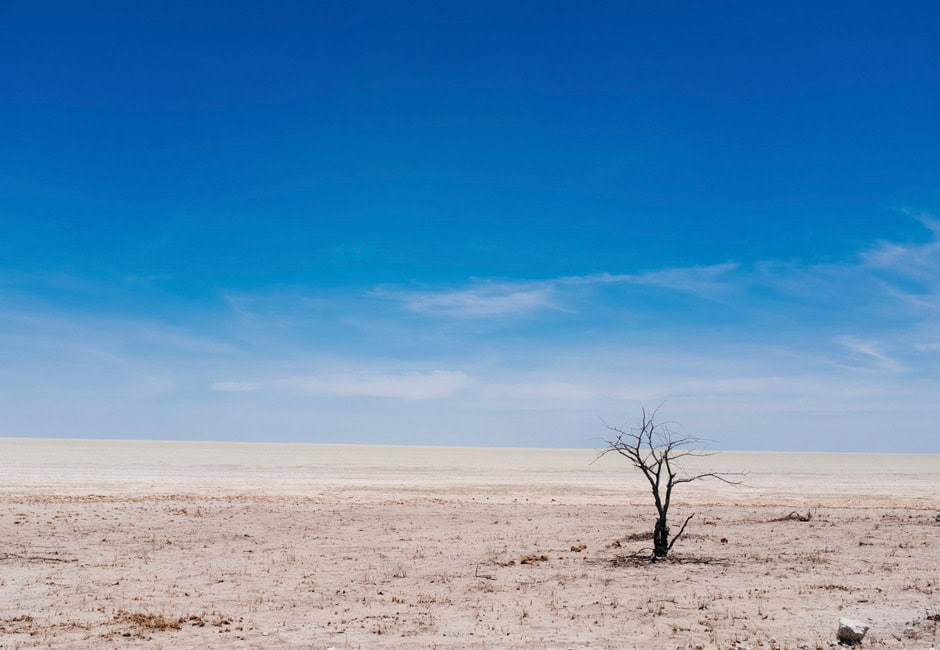
Etosha translates as something like "the great white place" and refers to the huge salt pan, more than 4,700 km2 in size, which adorns the eastern part of the park in particular with a breathtaking landscape. In the rainy season, water collects in the pan and the otherwise animal-free expanse fills with thousands of flamingos and numerous pelicans!
But the salt in the soup does not only taste good to them; it also helps other animals absorb important nutrients from the earth. Antelopes and zebras, for example, gather especially at the edges of the pan to regulate their nutrient balance with the precious mineral.
On top of that, on the southern edge of the pan the flat soils, with a stronger salty and alkaline mix on karst ground, provide equally "sweet" grazing. Since it also rains more on this side and, favoured by the karst land, there are more natural water sources than in the western part, you also find significantly more animals overall in the east of Etosha and especially on the southern edge of the pan.

The northern areas, extending into the west, are more strongly characterised by Kalahari sand or loamier soils. Combined with the better-watered eastern part, this leads to more woodland in the north-east of the Etosha Pan.
In the drier western part of the park, by contrast, the vast expanses are dominated by mopane trees. And even if the grasses may not be as tasty as in the eastern part, an astonishing number of herbivores seem to like it here too.
Which animals are there in Etosha National Park? An overview
The varied ecosystem of this huge bush savannah, with its seemingly inhospitable salt pans, offers habitats for more than 114 mammal, 110 reptile, 16 amphibian and 388 bird species (as of August 2024).

Apart from crocodiles, hippos and buffalo, pretty much every interesting wild animal can be found in Etosha National Park. A special feature – because it is not a given in all National Parks of southern and eastern Africa – is the species pairs of white and black rhino, Hartmann's mountain zebra and Burchell's plains zebra, and the black-heeled and black-faced impala.
But ground squirrels are in any case much easier to find. They look almost like tree-climbing squirrels but have a bushier tail. They like to hold this over their heads like a parasol when they are standing defenceless in the sun. There are also meerkats in Etosha National Park. Unfortunately, they are anything but easy to find. It is significantly easier with the yellow, dwarf and slender mongooses, which are just different species.
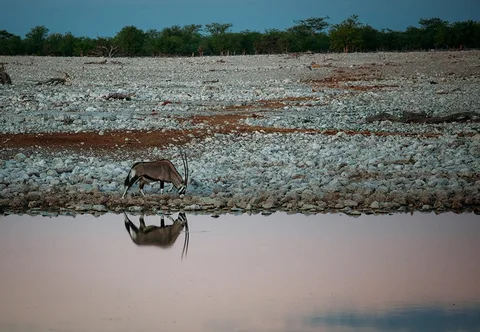
In Etosha, small and large animals bring great joy. Giraffes smile down at you, nocturnal honey badgers hurry back to their burrows in the morning. Elephants polish off the leaves of a tree together with its branches, springbok dance their unmistakable springbok ballet. When they jump, they push off with all four legs at the same time and, after their breathtaking flight, land again on all legs at once. None of the other antelopes – neither the elands, which are rare here, nor the wildebeest, oryx, kudus, red hartebeest, common duikers, dik-diks, steenboks, nor the impalas – can match the wearers of the Pirelli stripes when it comes to scoring technical merit.
The predators in Etosha, however, are hard to impress with the art of graceful movement. Following the motto "better to eat than applaud", lions, leopards, cheetahs, caracals, hyenas and jackals do their best to maintain the ecological balance and keep the growth of their prey animals in check. That is why you also see warthogs fleeing, when they are not busy ploughing up the grassy ground.

Can you see the Big Five in Etosha?
In Etosha National Park you can see four of the Big Five. Only buffalo are not found in Etosha. In Namibia you can find them either in Waterberg National Park or in the Zambezi Region, for example in Bwabwata National Park. For lions, leopards, rhinos and elephants, however, you don't have to travel any further; these four can be seen in Etosha National Park.
Your best chances are certainly with the elephants. They are the Big Five animals that are easiest to see in Etosha National Park. Their ghostly appearance is fascinating. But don't be afraid. They don't haunt the camps at night. Rather, it is their white coat, in which they clothe themselves after an extended mud bath or a dust shower with Etosha's almost white earth. Then they do full justice to their nickname as Etosha's "ghost elephants".

Even the white rhinos sometimes come across ghostly, wrapped in the same sandy Etosha breadcrumb coating. Suddenly you think you understand where they get their name "White Rhino". It is different with the black rhinos that live here, whose dark grey skin looks almost black next to their relatives, just like "Black Rhinos".
The lions, unlike the leopards and rhinos, are not exactly shy, but unfortunately often enough they are exactly where you aren't. Here it sometimes helps to look at the entries in the "sightings" books in the reception areas of the accommodation, or to stop oncoming cars and ask bluntly whether they have seen lions. By all appearances, apart from the salt pan itself, there is no corner of the park that is not claimed by one of the lion prides.

Unlike lions, leopards do not live in prides. Unless it is mating season or a leopardess is out with her cubs, they enjoy their solitary existence. On top of that, they prefer Etosha's woodlands. So despite their fascinating spotted pattern they stand out less and often escape the searching eyes of passers-by.
Want to find out more about Namibia trips?
We are happy to advise you. Get in touch with us!
Where do you see which animals in Etosha National Park?
Etosha's great speciality is the natural and man-made waterholes along the various driving routes through the park. Find the waterholes and you will discover the animals. Sometimes it takes a little patience. Or you simply drive on to the next one. The further into the dry season, the fewer the Etosha pubs and the fuller the crowd at the bar. That sounds simple and it is simple.

Still, you should keep your eyes open. After all, many animals also stay away from the drinking sources. This applies especially to the rainy season and the weeks after, when the precious water is spread all over the park: in puddles, in the hollows of fallen trees or in rock crevices. Guaranteed and well-distributed water sources exist in every season. They ensure the survival of the wildlife. But even though you find Etosha's wild animals widely distributed throughout the park, a few of them have certain priorities.
Which animals are there in Etosha National Park? Antelopes, zebras, giraffes and rhinos
Of the species pairs mentioned above, you find the black-faced impala especially often in the west and the black-heeled impala more in the eastern half. The mountain zebra, by contrast, lives only in the western part of the park, while the plains zebra is spread across all areas. The rhinos, however, you find … well … that is no longer talked about. No local details and no posting of rhino photos on social platforms is meant to help protect them from poachers. Yes, it has come to that.

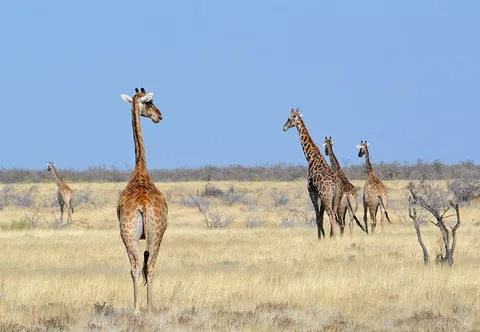
The small Damara dik-dik antelope, with its body fading into grey, is best found in the late afternoon on the Dik-Dik Drive around the Klein Namutoni waterhole. The considerably larger giraffes can be found throughout the park, but have a stronghold in the east, in the wider surroundings of the Koinachas and Chudop waterholes.
Where can you see elephants in Etosha National Park?
With elephants, by contrast, there are significantly more migration movements, which can look very different for males and females. The females, and above all the matriarchs of the family groups with the youngsters among them, pay much more attention to a good mix of water sources and nutritious vegetation. In a park with a complex ecosystem that can also be exposed to extreme drought, such movements are understandable.

The males, on the other hand, who are initially only responsible for themselves, can take greater risks in this respect and go their own way. Depending on the season, it can therefore quite happen that in the western part of the park, heavily dominated by mopane trees, you mainly find males, while the families stay largely in the more wooded north-east of the park.
Which big cats can you see in Etosha National Park?
Cheetahs have unfortunately become a rarity. In general you are more likely to see them in areas of open terrain, where here and there a bush offering cover or a shady tree stands. The last ones I saw hunted mainly around the Sueda, Salvadora and Charitsaub waterholes and in the vicinity of Fischer's Pan.
Leopards are also a bit hit and miss. In this park you could score a hit at waterholes that, like Rietfontein, Chudop or Klein Namutoni, still have good tree and shrub vegetation around them. In general, with leopards in this park you should not only look at attractive "leopard trees" but also look a lot into the dense undergrowth.
The lions, on the other hand, show themselves rather openly and invitingly, as long as they are lying in a cooling shady spot.
Two of our favourite safaris with a visit to Etosha National Park:
The waterholes at night
At night, too, the waterholes of the rest camps of Olifantsrus, Okaukuejo and Halali in particular are of very special quality. Those who bring patience here see not only diurnal animals that are also well disposed to a thirst-quenching sip at night. The typically nocturnal bar regulars also drop by. Zebras mingle with elephants, leopards with honey badgers, jackals with wildebeest and many more. These alcohol-free night spots are floodlit until the next morning.
Which floodlit waterholes are there?
Olifantsrus is a covered structure where you can sit inside and look down on the animals at the waterhole from above. It is a fantastic perspective. Okaukuejo is built like an amphitheatre, with seating in a semicircle and a night stage that is very easy to see. Halali, by contrast, offers natural stone seating and lies a few steps outside the camp. This raises the thrill but does not reduce safety. Even though you do everything at your own risk anyway.

When is the best time to travel for wildlife viewing in Etosha National Park?
Just because it is rightly said that you can visit Etosha National Park well all year round, it does not mean that conditions are the same all year.
From November to April it is the rainy season and particularly hot. A good time for friends of green and comparatively lush vegetation, who also like the flair of green meadows in an otherwise dry savannah. It is also the time of dramatic cloud formations over huge plains. And it is the time for those who want the full programme with snakes, spiders and scorpions. The greatest number of birds is also on the move in these months. They keep the swarms of mosquitoes, which are likewise about now, in check. And even the park's iconic ostriches are probably glad of the colourful flock of birds, because they themselves are temporarily not quite so much the centre of attention. That is relaxing.

In the dry season from May to October, more and more waterholes dry up and the animals that there are in Etosha National Park increasingly gather at ever fewer remaining drinking spots. While the landscape, apart from a few green patches, slips into a grey garb, things get ever more colourful at the water oases. Animals stream in from all directions. What you get to see here in the way of wildlife at this time can quickly take your breath away. It is reminiscent of "The Animals' Conference", the "Jungle Olympics" or an animal parade convened by the Lion King himself. Suddenly a planned short visit turns into a whole afternoon at the waterhole.
How do I get around? Different types of safari
The main means of transport on an Etosha safari is of course a vehicle, one with four wheels and a car-like body. In plain terms: bicycles and motorbikes have to stay outside.
Self-driving is permitted in the park, but a guided private safari or a guided group tour is recommended. Travelling alone with a vehicle in Etosha gives you a certain flexibility and freedom. With a few Namibia tips for self-drivers, most people manage well in a rental car in Etosha too, despite the uncertainties and dangerous situations that can arise. Despite the many dirt roads, you get through very well with two-wheel drive and raised ground clearance, at least in the dry season.
On guided tours a guide accompanies you with his or her four-wheel-drive safari vehicle. You can sit back and relax, admire the wildlife and enjoy the game drives. A guide drives you around, takes responsibility for the trip organisation, shows you the sights and tells you everything worth knowing about the park and its animals.

Really, you only have to decide briefly beforehand whether you want a privately guided trip, where you determine the timing, the destinations and your fellow travellers before booking. Or whether you want a guided group tour, where dates and destinations are set and where you meet strangers who want to travel more affordably and get to know like-minded fellow travellers. Either way, with all the excitement over this thrilling wildlife, you don't run the risk of suddenly forgetting that traffic drives on the left here.
Packing tips: what should I take on an Etosha safari?
You can conveniently get a quick overview of what you should have with you for an Etosha safari on our packing checklist here. But you are also welcome to look into the topic of packing for a safari more generally. So let me just highlight a few points here:
- The park is either too hot or too dry. So take plenty of water with you in every season.
- If you are on a group tour in the Land Cruiser, don't take a hard-shell suitcase but a soft bag.
- The malaria risk in Etosha is modest, but still discuss with your doctor how best to protect yourself against malaria.
- Don't forget your binoculars.
- And take a good telephoto lens for photography (at least the equivalent of a 400mm telephoto lens for SLR cameras).
In any case, we warmly welcome you to this wonderful country of Namibia and the unique Etosha National Park, and we are happy to answer further questions and support you in planning your Namibia trip.
Thanks to our close contact with our subsidiary in Namibia, we always know exactly what the current situation is. So get in touch with us! Your dream, our expertise – your very own individual Namibia experience.
Juan Proll has lived in southern Africa since 2011 and works as a certified nature and cultural guide in South Africa, Botswana and Namibia for Elefant-Tours and its subsidiaries. After an earlier career as an adult education teacher in Germany, he swapped the classroom for the wilderness. Alongside his work as a guide, he writes for the Elefant-Tours blogs about nature, culture and sustainable travel. Juan is a member of the Field Guides Association of Southern Africa (FGASA) and the author of the books "Ich werd' dann mal Ranger" and "Das Safari-Lesebuch". The magazine DER SPIEGEL reported on his training.