Tipping in Namibia: what is customary and appropriate?
 by Juan Proll· January 5, 2026· 14 min read· Updated January 8, 2026
Whether in restaurants or hotels, or after guided tours with local guides, many tourists ask themselves: “What about tipping in Namibia: what is customary and appropriate?” Today's blog has the answers.
Why tipping matters in Namibia
First of all: tipping in Namibia is not compulsory but voluntary.
At the same time, however, it is expected and appreciated in the tourism sector as a fixed part of the service culture. This practice has become established over many years and is deeply rooted in the Namibian tourism industry.
Unlike in Europe, where tipping is often genuinely optional, it plays a more important role in Namibia. Salary structures in Namibian tourism traditionally take into account that tips make up part of the income, much as in other countries with an established tipping culture. For guides, service staff and hotel personnel, a tip is therefore an expected and factored-in part of their income.
That is why it helps to see tipping as part of the travel experience. It not only brings a smile to the faces of service staff, but also strengthens the tourism sector in Namibia.
How much should you tip in Namibia? An overview
In Namibia, tipping is an important part of hospitality. That does not mean, however, that you have to tip for poor service. Here are the most important rules of thumb for the different service areas of the country:
General rules of thumb
In Namibia, a tip is often seen as a sign of appreciation for good service. Usually you give 10% of the bill, depending on the service.
In general, even a small contribution can make a big difference. For example, a petrol attendant who fills your car with fuel, washes the windows and checks the tyre pressure will be happy about a modest N$5–10 (approx. €0.25 to €0.50) – more than you would ever miss.
At the counter of a bar and in a taxi, on the other hand, you can round up the bill or leave a fixed amount of around N$10–20 (approx. €0.50 to €1) as a tip.
Different rules, with tips of varying amounts, apply to hotel staff and lodges as well as to safari guides. More on that below.
Two of our favourite trips in Namibia:
Differences between restaurant, hotel/lodge, safari, city/countryside
In a restaurant or resort you generally pay a tip of 10% for table service, gladly up to 15% for particularly good service.
Tipping staff is also customary in lodges and hotels. We recommend a flat rate of at least N$50 (€2.50) per night per room.
Safari guides are very important for an unforgettable safari experience and, on half-day and full-day tours, receive a tip of between N$50 and N$100 (approx. €2.50 to €5) per person for group safaris and up to N$150 (approx. €7.50) per person per day for private safaris. You should give an extra driver or tracker half of the tip you pay the guide.
If you are on a multi-day safari, we recommend a tip of €5–7.50 (or N$100–150) per person per day for the guide.
In the city or in the countryside, the tipping recommendations mentioned above do not differ, but staff in rural areas, because of their remoteness and the distance to the nearest bank, are more pleased to receive a cash tip in local currency.
Appropriate tipping
An appropriate tip is
- around 10% of the bill in restaurants and cafés,
- rounding up the bill or N$10–20 (approx. €0.50 to €1) at street stalls, in bars or in taxis,
- around N$50 (approx. €2.50) per night for hotels and lodges
- and N$50–150 (approx. €2.50 to €7.50) per day for the guide on safari tours.
Too much or culturally inappropriate
A higher tip (more than 15% of the bill) can be perfectly appropriate in individual cases. At the same time, however, it can generally be seen as inappropriate, as it exceeds the local value of a tip.
As a general rule, the tip should be appropriate and in proportion to the service, without going overboard.
Tipping guides, trackers & drivers
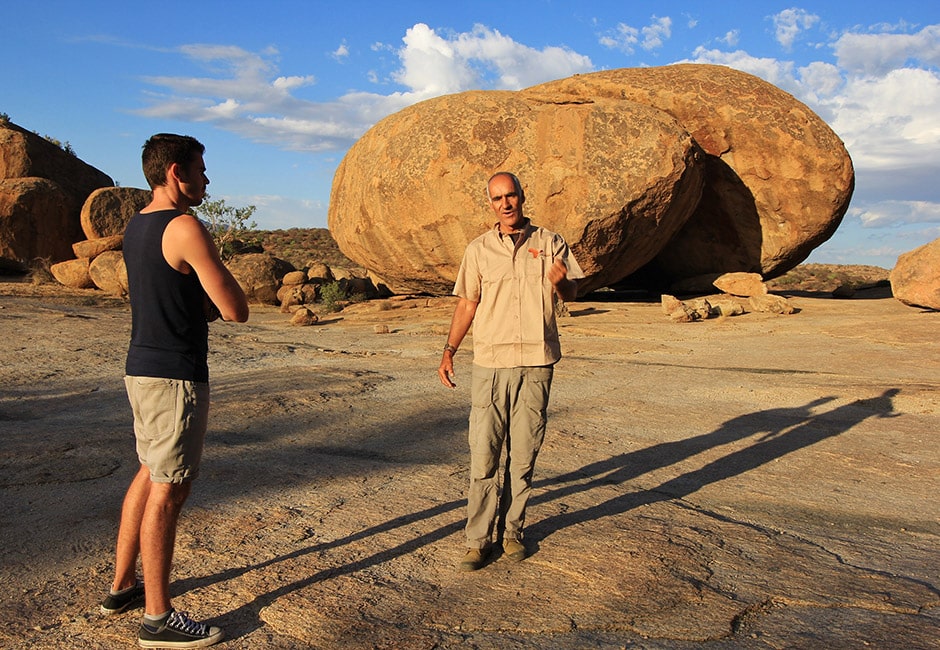
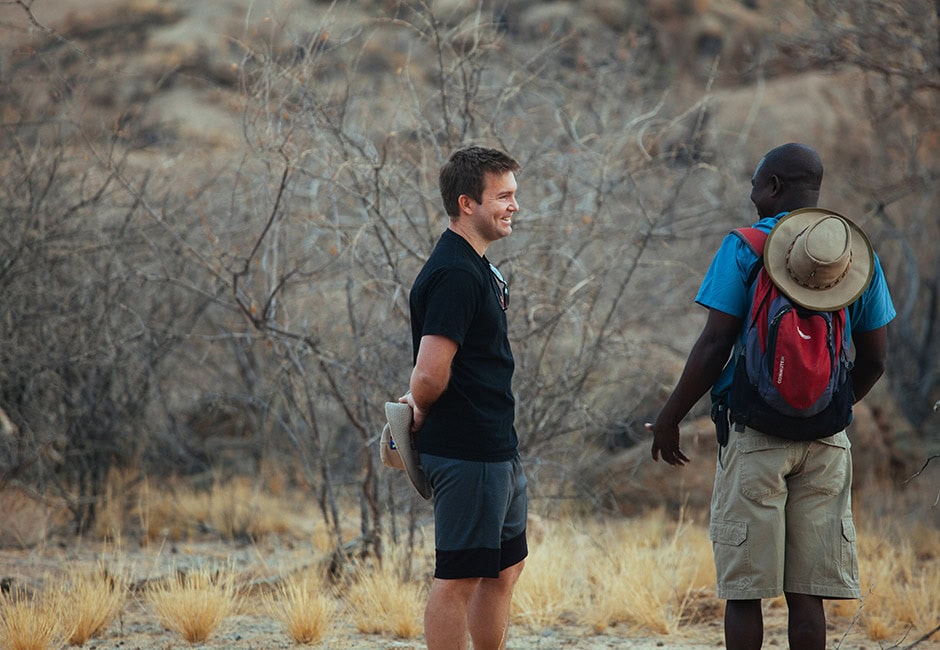
Guides, trackers and drivers are the link between you and an unforgettable holiday in Namibia. Showing you their country is something they care about deeply. However, the tipping recommendations for them are different.
Safari guide (driver-guide)
Safari guides play an important role in making your safari an unforgettable experience. They use their knowledge and skills to familiarise you with the land and its people and to help you spot and identify wildlife. They are often both guide and driver at the same time, showing you the sights.
A tip for them is therefore customary on half-day and full-day tours in the Land Cruiser and is between N$50 and N$100 (approx. €2.50 to €5) per person for group tours and N$100–150 (approx. €5 to €7.50) per person per day for private tours.
If you are on a multi-day safari, the guide works significantly more hours per day. We therefore recommend a tip of at least €5–7.50 (or N$100–150) per person per day.

Trackers, rangers & drivers
If an extra driver or tracker is with you in addition to the safari guide, you should give him or her half the amount you gave the guide, especially if he or she contributed a great deal to the experience.
Trackers are at most part of half-day and full-day tours and would appreciate N$25–50 (approx. €1.30 to €2.50) per person on a group safari, or around N$50–75 (approx. €2.50 to €4) on a private safari.
Drivers who accompany the safari guide on a tour can be rewarded with N$25–50 (approx. €1.30 to €2.50) per person on a group safari and with around N$50–75 (approx. €2.50 to €4) on a private safari. If they accompany you for several days, we recommend N$60–80 (approx. €3 to €4) per person per day.
Tipping in restaurants & cafés
If you eat at a restaurant or resort, a tip of 10% for table service is generally given for good service, and gladly more for particularly good service.
When you get the bill, however, check whether a service charge has already been included. It is not customary, but it does happen. In that case you naturally do not need to give an extra tip.
At restaurants with buffets or self-service, a tip is generally not expected unless you were served personally.
In casual places such as street stalls or bars, it is enough to round up the bill or to give N$10 to 20 (approx. €0.50 to €1) as a tip, regardless of the total bill.

Tipping in hotels & lodges
Shared tip boxes in lodges
In lodges and hotels, tipping staff is customary. A flat rate of N$50 (€2.50) per night is often recommended here. Many accommodations have a dedicated central tip box at reception so that tips can be shared fairly among all staff, including receptionists, cleaners, porters and maintenance staff.
It is best to pay your tip all at once at the end of your stay rather than after each individual service.
Room cleaning staff / housekeeping
If you want to limit your tip specifically to the room staff rather than use the tip box at reception, I recommend N$20 (approx. €1) per day. In that case it is best to pay straight away, because tomorrow someone else may already be responsible for your room.
You would need to make it clear to this person, either in words or by handing it over directly. Simply leaving it silently on the bedside table or another surface only works on the day of departure. Otherwise it will be left untouched.
Porters
As a rule, porters are also covered by the flat tip of N$50 (approx. €2.50), which goes into the accommodation's general tip box when you leave. If you want to pay them individually, N$10 (approx. €0.50) is usually enough.
You are welcome to pay airport porters N$20 (approx. €1), as the airport is not particularly large and only short distances are needed. In addition, even porters here nowadays use the handy luggage trolleys in a very modern way.
Reception & other staff
Reception staff are likewise generally covered by the flat tip of N$50 (approx. €2.50), which goes into the accommodation's general tip box when you leave.
It should be an exceptional service before you pay an extra tip of an amount you choose yourself. This could be, for example, a great deal of coordination effort to fulfil your special wishes.

Tipping car guards, activity providers & other service providers
For the following service groups too, there are no fixed rules, only general recommendations that can give you some guidance:
Car guards / shopping bag carriers
In Namibia there are a whole range of occupations that we simply do not know in Central Europe. These include the car guards in inner-city streets, at special event venues or in restaurants, or at tourist hotspots, who are happy to assign you a safe parking space and keep an eye on your car.
The helpers at supermarket checkouts, who put the groceries into bags for shoppers and are then happy to carry your shopping to your car, are also little known to us.
They all offer their modest services in the hope of a small tip, which helps their survival and that of their family. For them, the recommended amount is N$5–10 (approx. €0.25 to €0.50).
Activity providers (boat trips, dunes, quad, kayak, bush walk)
For all your activities, it naturally depends on whether someone accompanies or leads you. On a boat trip this is usually the case. If the captain also tells you something about the waters, the ecosystem and the wildlife, a tip is appropriate.
On a 2- to 3-hour bush walk with a guide, the conditions for a tip are likewise met.
In both cases the recommended amount is N$20–50 (approx. €1 to €2.50) per person, depending on the activity and quality.
If, on the other hand, you are out on your own in a kayak or on a quad, a tip is unnecessary.
Local guides on cultural visits
A popular way to get to know the country, its people and its culture is to visit ethnic groups or community projects living traditionally. Here there is usually a donation box that you can feed with a small contribution, which, depending on the project and your impressions, may sometimes exceed the recommended amount of N$20–50 (approx. €1 to €2.50).
On Himba visits in the far north-west (Kaokoveld), guides tend to invest part of your payment in food and everyday items, which they hand over to the Himba on your arrival. That leaves only the tip for the local guide who leads your tour. The recommended amount for the guide is N$30–60 (approx. €1.50 to €3) per person.
Want to travel to Namibia?
Plan with our travel experts – get started here!
Tipping for taxis & transfers
A group we know very well is taxi and shuttle drivers, who are plentiful above all in the cities.
Taxi drivers in cities
Taxi rides within the city generally have a fixed price. Through your accommodation you not only find out how much the ride costs, you also get a taxi that the accommodation trusts.
Tipping is not compulsory here either. If you do tip, it can be rounding up the amount or N$5–10 (approx. €0.25 to €0.50) extra.
If you travel during rush hour or further out of the city, N$10 (approx. €0.50) is still fine.
Private transfers & airport shuttles
Private transfers and shuttle service journeys usually go far out of the city, for example when travelling from Windhoek city centre to the international airport or when you drive from Windhoek to Swakopmund.
Tips are again not a must, but depending on the distance and service can be N$10–20 (approx. €0.50 to €1) per person.
What if I'm not sure? Practical tips
If you are unsure how much to tip in Namibia, a few practical tips will hopefully help:
- Watch other guests: In some situations, such as guided activities, you can see how much other guests give.
- Small amounts are fine too: If you are unsure, smaller amounts such as N$5 (approx. €0.25) for the car guard or petrol attendant also help. It is still appreciated!
- When in doubt, ask: Feel free to ask the hotel management or your guide what is customary. They will be glad to help. If you are travelling with other guests, you can also ask whether they know more.
- Simply round up: If you are unsure about a bill, simply round up to leave a tip without much thought. Or simply apply the 10% recommendation where a service has a price.
- Check the bill: Before you tip in a restaurant, quickly check the bill to see whether a tip has already been included automatically.
- Choose cash or card: You can generally pay bills well by card, including the tip. It does no harm, however, to ask the staff whether the tip actually reaches them. If in doubt, you can pay the tip in cash instead. The same applies in rural areas, where there is no bank nearby for the staff.
- Quality of service: Remember that a tip is only meant for good service.

What should I avoid?
In Namibia there are a few things you should avoid when it comes to tipping, in order to prevent misunderstandings and stay respectful:
- No tip for poor service: An appropriate tip should always reflect the quality of the service.
- Giving inappropriately high tips: A generous tip is nice, but very high amounts could be perceived as rude or inappropriate.
- Giving “gifts” instead of money as a tip: In Namibia, tips are normally given in cash rather than as gifts such as food or other goods, where you can easily go wrong.
- Tipping too late: A tip should be given promptly, ideally straight after the service. Only in hotels do you not tip for the individual service, but at the end of the hotel stay for the overall service.
- Tipping in foreign currency: A tip in the local currency always has priority. In the end, though, euro or USD notes are better than no tip at all for good service. Coins in foreign currency, on the other hand, are useless because they cannot be exchanged.
Frequently asked questions about tipping in Namibia
Do I always have to tip?
No, tipping is not obligatory, but it is seen as a sign of appreciation for good service. If the service was good, it is customary to give a tip.
If the service was poor, you can also leave it out or give only a small amount.
How much do you tip on a guided round trip in Namibia?
For safari or tour guides, N$50–100 (approx. €2.50 to €5) per person is customary on half-day and full-day tours. On privately guided tours, up to N$150 (approx. €7.50).
On multi-day tours, the guide works significantly more hours per day, so a tip of around N$150 (approx. €7.50) per person per day is recommended. If you are travelling with a larger group, the amount may be somewhat higher depending on group size.
For drivers, N$25–80 (approx. €1.30 to €4) per person is appropriate, depending on the length of the tour.
Do I tip at every lodge?
Yes, it is customary to tip at lodges in Namibia, especially for room staff, porters and other employees. The amount varies, but a flat N$50 (approx. €2.50) per night for all hotel staff is usual.
You can give more or less depending on the service and, as a rule, put the money into a tip box at reception. The hotel's own safari guides are the only ones who receive their tips separately from the guests.
Is it better to tip at the end or daily?
Both are fine. A daily tip shows that you appreciate the service regularly, while a single tip at the end of the trip is a lump-sum acknowledgement. It depends on your personal style and the type of service.
At least in hotels and with guides, however, it is customary to hand over the tip at the end of the services.
Should I use cash or envelopes?
Cash is the preferred method for tipping in Namibia. Envelopes are not necessary.
If you would like to do it with a bit more style, though, you are welcome to use an envelope to hand over the tip, especially for larger amounts and if you have been travelling with the person concerned for a longer time. Guests often add a nice signed card as well.
How does tipping work as a group?
A group can set up a shared pool for tips if there is not just one recipient but several. The amount is then distributed equally or on a graded basis. Guides in Namibia tend to prefer it when guests make the split themselves and hand over the tip accordingly.
A group can also consider whether to collect the tip and pass it on in an envelope with a nicely written and signed card, or whether all parties in a group would rather handle it individually and hand it to the guide and driver personally.
What should I do if the service was poor?
If the service was poor, you can decide not to tip or to pay only a minimal amount. It is important to stay respectful and, if necessary, to express your dissatisfaction directly and politely to avoid misunderstandings.
Conclusion – tipping in Namibia with respect & common sense
In Namibia, tipping is a very appreciated way of recognising good service. But it should always be given with respect and common sense. It is not obligatory, but is generally expected for special service.
Make sure the tip matches the quality of the service – too much or too little can seem inappropriate and call the appreciation into question.
As a general guideline:
- for service in restaurants, a 10% tip is the norm,
- in hotels a flat N$50 (approx. €2.50) per night and
- for guides, depending on the offering, between N$50–150 (approx. €2.50 to €7.50) per person per day.
In principle, though, smaller amounts are also welcome, especially for car guards, petrol attendants and shopping helpers.
Remember that tipping is not compulsory. If the service was poor, you can leave it out or reduce it. Overall, it is about acting with fairness and gratitude and respecting local customs.
If you still have questions or need support planning a trip to Namibia, whether you travel on a guided group tour, a guided tailor-made trip or a self-drive tour, you are welcome to contact us.
Thanks to our close contact with our subsidiary in Namibia, we always know exactly what the current situation is.
So get in touch with us! Your dream, our expertise – your very own individual Africa experience.
Juan Proll has lived in southern Africa since 2011 and works as a certified nature and cultural guide in South Africa, Botswana and Namibia for Elefant-Tours and its subsidiaries. After an earlier career as an adult education teacher in Germany, he swapped the classroom for the wilderness. Alongside his work as a guide, he writes for the Elefant-Tours blogs about nature, culture and sustainable travel. Juan is a member of the Field Guides Association of Southern Africa (FGASA) and the author of the books “Ich werd’ dann mal Ranger” and “Das Safari-Lesebuch”. His training was covered by the magazine DER SPIEGEL.