When is the best time to travel to Namibia and South Africa?
 by Juan Proll· August 11, 2025· 14 min read
Two countries that could hardly be more different, yet are often visited together. But when is the best time to travel to Namibia and South Africa? And what recommendations follow from that for your trip?
Why the travel season matters so much
Holiday time is precious, full of expectations and travel dreams. Being in the right place at the right time is crucial to fulfilling all your wishes as fully as possible. So you are well advised to know the best time to travel for a holiday in Namibia or South Africa that suits you.
Different climate zones and landscapes
Together, Namibia and South Africa stand out for their great variety of climate zones and landscapes. There is something here for everyone in every season.
You will be surprised how scenic the desert country of Namibia is. Bare, rugged mountain and valley scenes, dune fields against ocean backdrops, river courses winding through dense woodland.
South Africa fascinates simply because you can spend almost the whole year either only in the sun or only in the rain – if you want to. Spectacularly varied coastal, mountain, forest and wine-growing landscapes are only the logical consequence.
And on top of that, the savannas of both countries offer endless wildlife for all safari lovers.

Trip planning depends on weather, wildlife sightings & activities
The weather, the quality of wildlife sightings and the possibilities for activities quickly influence your planning for the best time to travel in Namibia and South Africa. Know when, how and where, and in glorious sunshine you will see countless animals at the waterholes or even float above them in a hot-air balloon.
Or you love photography and want lush, fresh colours in the vegetation, plus dramatic breaks in the clouds with blue-grey contrasts and shimmering sunbeams.
Perhaps you are looking for the time of the many young animals or the returning migratory birds, or you want to relax on a hike, or perhaps enjoy beaches and bays.
Even a boat trip to the whales off Hermanus or a stroll among wildflowers needs planning.
Dry season vs. rainy season – what does it mean for travellers?
Dry and rainy seasons alternate in Namibia and South Africa. The amount of rainfall is strongly seasonal and varies by region.
The Namib Desert and the semi-desert Kalahari already hint at it: it rains less in Namibia. South Africa, by contrast, is rainier.
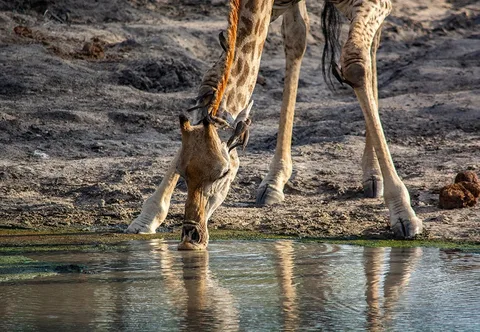
In general, the dry months offer ideal safari conditions. The vegetation thins out, and the animals become more visible. At the same time, water grows increasingly scarce, so animals concentrate more and more at the dwindling number of remaining water sources.

If there is heavy rainfall, some stretches of road can quickly become impassable. Sometimes it is enough to wait until the floodwaters recede. Often, however, it means driving detours. But then the adventure is with you.
Fortunately, the rainy season does not bring non-stop watering. In South Africa's Cape Town region, it nevertheless stays unpredictable. In the safari regions, by contrast, the rain mostly comes in the afternoon.
That leaves you plenty of dry moments to enjoy, during the rainy-season months, above all lush green and very photogenic landscapes. It is also the time of the many young animals with a high “aww, how cute” factor, and of the migratory birds, which bring even more colour to this travel paradise.
Two of our favourite trips in Namibia and South Africa:
When is the best time to travel to Namibia?
You can travel to Namibia wonderfully all year round. Your individual best time to travel depends very much on what you want to see and experience on your trip.
On our blog you will find all the details about the best time to travel in Namibia.
General climate pattern in Namibia
The Namib in the west and the Kalahari in the east mean a very dry climate in Namibia. Around 300 sunny days a year speak for themselves. You will find rain in the northern regions of the country, especially in the northeast in the Zambezi Region.
In the rainy season from November to April it rains a little more here and a little less there across the whole country. In the highlands, the capital Windhoek also enjoys regular showers. It is also the hottest time of the year, when the temperature easily exceeds 30 °C.
It is the season for adventurers and 4×4 fans. They get their money's worth especially between January and March, when the rain – if it comes – sets the odd nice challenge.
In the dry season from May to October it gets properly cold at times. During the day, however, temperatures stay pleasant at around 20 °C. At night it cools quickly to 5 °C, and in higher areas sometimes below 0 °C.
Wildlife viewing in Etosha National Park
The ideal time to travel for a safari in Etosha National Park is between June/July and October. Then animals are generally easier to spot. The vegetation is parched, and waterholes disappear one by one. So the animals are driven to the ever fewer remaining waterholes.
If you would rather encounter snakes, scorpions and spiders, you should drop by between October and April. The hotter months – especially combined with rain – lure them out of their holes.
Bird lovers, too, will see more at the start of the rainy season from November. Many migratory birds look forward to Namibia's approaching hot and, hopefully, rainy season.

Highlights such as Sossusvlei, the Namib Desert & Damaraland
The best time to travel to the Namib Desert in general and Sossusvlei in particular is, for many, June to September, when temperatures are bearable and rainfall is unlikely.
However, at this time you will meet more people and be travelling in the dustiest months. The same applies to Damaraland on the edge of the Namib, where you can encounter desert elephants and desert lions, but also many other animals.
Self-drive tours & road trips in Namibia – when is it most pleasant?
Unless you are specifically seeking a 4×4 adventure, you are safest on a self-drive round trip in Namibia in the dry season from June to October, and you will also find these months the most pleasant.
This is partly down to the roads, which for the most part are gravel tracks that turn muddy and challenging in too much rain, but in the dry season are at worst “only” very dusty.
And it is partly down to the advantages of the dry season. It makes it easier for you, even as a concentrating self-driver, to glance out of the window left and right, spot animals or enjoy the landscapes.
Best time to travel for photographers and nature fans
If you love photography beyond holiday snaps, you will experience the country at its most contrasting between January and April. Like works of art, clouds and wisps of cloud blend into the blue of the sky. The green of the grasses and the colourful birdlife bring colour to the wilderness.
On the road, this season also writes more stories of dry or muddy roads, of lush vegetation and many young animals breathing new life into the landscape.
But if you want to photograph the starry sky, the time between June and September is the best.
Want to find out more about Africa trips?
We are happy to advise you. Get in touch with us!
When is the best time to travel to South Africa?
Very different climate zones, two oceans, excellent swimming and water sports, superb hiking in the mountains and along the coasts, safari game reserves in abundance and sights scattered across the whole country – South Africa is a very diverse top holiday destination all year round.
Climate zones at a glance – Cape region vs. Kruger & the northeast
South Africa is almost three and a half times the size of Germany, has varying altitudes and two fundamentally different ocean influences. The Indian Ocean along the east coast brings mild sea air.
In contrast, the Atlantic in the south and above all the Atlantic Benguela Current along the west coast deliver cool ocean currents. As a result, the best time to travel in South Africa differs greatly by region and season for climatic reasons.
The winter months in South Africa – especially June, July and August – can be very rainy in the Western Cape, above all in Cape Town and along the southern coast. Even so, daytime temperatures can reach 16 to 17 degrees and rarely drop below 5 degrees at night.

In the same months, the northeastern interior “overwinters” almost without exception dry, for example the region around Johannesburg across to Kruger National Park. Blue skies and sunshine spoil all fair-weather seekers, with daytime temperatures above 17 degrees.
In the South African summer between October and March/April it is the other way round. While the Cape Town region is dry, it can rain so heavily from Johannesburg to Kruger National Park that it causes regional flooding – a true South African experience.
Cape region & Garden Route
When the rainy season in the Cape region gives way to spring in September, the rainfall eases, the wildflowers bloom and temperatures rise, the best time to travel along the Garden Route begins too.
The Mediterranean coastal climate, the lush green growth and the manageable flow of tourists make for the most enjoyable moments between September and early December. After that it gets increasingly hotter and busier, both in Cape Town and on the Garden Route.

Safari in Kruger, Hluhluwe & Madikwe
In Kruger National Park, Hluhluwe-iMfolozi Park and Madikwe Game Reserve, the South African “winter”, which is synonymous with the dry season from May to October, brings warm, dry and sunny conditions.
It is no longer hot enough for the snakes and scorpions, too dry for the mosquitoes and too cool for the birds to stay.
At the same time, the grass fades, the vegetation thins out, and water becomes scarcer and shrinks to a few year-round water sources. Between May and October, the animals gather at these few remaining drinking oases.
For travellers who come mainly for Africa's wildlife, May to October is therefore the best time to travel to these game reserves.
Whale watching in Hermanus & coastal regions
Very popular among travellers is the whale season in Walker Bay off the coastal town of Hermanus from July to November. The atmosphere on land during the whale season is unique. Especially between August and October you can often spot whales in the bay from the promenade.
Hermanus also boasts the world's only “Whale Crier” as well as the Whale Festival held every September to celebrate the arrival of the whales.
Hiking, wine & wildflowers – seasonal specialities
A real recommendation in the Western Cape region and further north in Namaqualand is the wildflower bloom from mid-August to the end of September. In this spring-like season, the fields, farms, arid areas and dunes here are transformed for a few precious weeks into a colourful carpet of flowers.
The grape harvest season in the wine-growing regions in and around Cape Town between February and April is also exciting. Many farms have their gates open to the spontaneous guest.
Here you can enjoy for a few hours the magical appeal of vast vineyard and parkland landscapes. The many guaranteed hours of sunshine, beautifully laid-out garden restaurants amid Cape Dutch architecture and a touch of 350 years of wine tradition conjure up the loveliest day-out feeling, with or without a glass of wine.

Is there a best time to travel to Namibia and South Africa?
The climate zones of the two huge countries are very different, so it is difficult to pinpoint a best time to travel to Namibia and South Africa as combined destinations.
In Namibia, the dry season from June to October is generally considered the most popular time to travel.
However, the climate zones within South Africa are so different that it is hard to name a single best time to travel for the whole country.
Cape Town and the Garden Route are especially beautiful from October to March. A Kruger Park safari is best done from July to September.
So if you had to commit to one month, you could name September as the best time to travel to Namibia and South Africa.
Should you combine South Africa and Namibia on one trip?
As both countries are very large and there is an incredible amount to see and experience, we usually recommend visiting either Namibia or South Africa.
And heading for the second country on a second trip! Whether you should travel to Namibia or South Africa first? Our comparison of the two popular destinations can help.
If you still want to experience both countries on one trip, it is best to plan the travel season, route and logistics with our experienced Elefant-Tours experts.

Namibia vs. South Africa through the year: month by month
If you are wondering what you can do best where in Namibia or South Africa in each quarter of the year, the following overview will help.
January to March – green, hot and surprisingly diverse
Namibia: Officially it is rainy season. The further south you go, the less you notice it. But in the north, northeast and highlands you will find lush green landscapes, great light for photographers and hardly any tourists – ideal for quiet desert trips & birdwatching.
South Africa: It is high summer at the Cape. The perfect time for the beach, wine regions and the Garden Route. Safaris in Kruger National Park, on the other hand, are hot, humid and often rainy, but scenically beautiful and full of birds. However, animals are not always easy to spot.
April to June – start of the dry season & ideal time to travel
Namibia: The heat gives way to more pleasant coolness. It is dry everywhere and increasingly clear. The vegetation thins out, and many waterholes disappear. The animals become more visible, and tourism picks up. From May, ideal for hiking in Fish River Canyon and in the dunes of Sossusvlei.
South Africa: In Kruger National Park, Hluhluwe-iMfolozi Park, Madikwe Game Reserve and iSimangaliso Wetland Park, conditions for a good safari improve. The weather now also invites you to go hiking, for example in the UNESCO World Heritage Site of the Drakensberg.
July to September – safari high season & wildlife highlights
Namibia: It is the best time for wildlife viewing at the waterholes in Etosha National Park. In search of water, the desert elephants can be seen more often near people. Clear nights invite star photography.
South Africa: It is the top time for safaris in Kruger National Park. Otherwise, too, August and September are full of highlights across the country: including the whale season off the coast of Hermanus and wildflower season in West Coast National Park and in Namaqualand – perfect for combination trips.
October to December – in-between seasons & changing climate
Namibia: It is the transition to the rainy season and already very hot. Wildlife, farmers and the waterworks look forward to the first rain. The pregnant females begin giving birth to their young. From November there are also mass births among the seals at Cape Cross.
South Africa: Early summer arrives at the Cape – ideal for Garden Route tours, Cape Town, coastal and wine farm visits. In the northeast, the main safari season slowly comes to an end. October is often still good for safari tours, though. The season of young animals begins, and the whales off Hermanus are still there.

Frequently asked questions about the best time to travel
Here are quick answers to a few more questions.
How hot does it get in Namibia in summer?
The Namibian “summer” runs from October/November to April. In many parts of the country it is rainy season. It gets very hot and also more humid. Even in higher-lying Windhoek (around 1,650 m), daytime temperatures happily reach over 30 °C and fall to around 19 °C at night.
In the deserts and in the south of Namibia, it can quickly get over 40 °C in summer.
The contrast in the dry season is striking, when temperatures can be around 30 °C cooler.
Can you travel in the South African winter?
The South African “winter” falls in the months May to September. And yes, you can travel wonderfully then. Above all safari fans get their money's worth in top destinations such as Kruger National Park or Hluhluwe-iMfolozi Park – it is dry, sunny and not too hot. The same applies to many beaches on the Indian Ocean.
It is rainy, on the other hand, in the Cape region, especially between June and August.
What about malaria – does the travel season play a role?
Regardless of the time of year, there are malaria-free areas in both Namibia and South Africa.
In areas that are not malaria-free, however, the risk rises with the arrival of the rainy season. Here the travel season does play a role. If you want to reduce the malaria risk, it is best to choose the dry-season months. Either way, you should make malaria prophylaxis a priority.
Are there seasonal price differences for lodges & safaris?
A clear “yes” to this question. Many accommodations inside and outside the national parks, in the countryside and in the city have seasonal differences. The same goes for safari prices. As a rule, tourist numbers and costs fall in the rainy season.
Is the rainy season a problem for self-drivers?
The rainy season can become a problem for self-drivers, but does not have to. Of course, it depends on how intense the rain is, which corners you are travelling in and whether you have the right vehicle. For all eventualities it should be a four-wheel-drive car.
Apart from that, roads and access routes can be blocked by the weather.
When is the high season in Namibia?
High season in Namibia is above all the time between June and September. Then the national parks and towns are full of tourists, accommodation is more expensive and availability is limited. If you plan to come at this time, you should book as early as possible.
When is the high season in South Africa?
South Africa has regionally different high-season periods. In the Cape Town region and on the Garden Route it runs from October to April, peaking between December and February. In the northeast, with its top safari destinations, it is May to September.
It gets really busy above all during the country's holiday periods, for example from mid-December to mid-January.

Conclusion – When is the best time to travel to Namibia and South Africa?
In summary, I can say that the best time to travel to Namibia and South Africa depends heavily on your individual interests and planned activities.
For Namibia, the months from May to October are ideal, because in this period the dry season makes wildlife viewing in the national parks easier, the roads are easy to drive, the sky is crystal clear and the landscapes are breathtaking.
South Africa, by contrast, offers several best times to travel. As in Namibia, the months from May to September are good here for wildlife viewing, such as in Kruger National Park and other reserves, as the weather is dry, the vegetation is thinned out, water sources are scarce and the animals are easier to see.
Another best time to travel is in South Africa's west, south and southeast in the summer months between October and April. Cape Town, the beaches and bays around it and the wine farms for wine lovers are popular then, as the weather is warm and sunny.
Overall, it is worth choosing your travel season according to the activities you want: for safari adventures in South Africa, the local winter in the northeast is optimal, while for culture, beaches and wine trips, summer in the Western Cape is a good choice.
For questions and further support in planning your trip, we are happy to help, whether you are travelling on a guided tailor-made tour or a self-drive tour.
Thanks to our close contact with our subsidiaries in Namibia and South Africa, we are always well informed about the current situation. So get in touch with us! Your dream, our expertise – your very own Africa experience.
Juan Proll has lived in southern Africa since 2011 and works as a certified nature and cultural guide in South Africa, Botswana and Namibia for Elefant-Tours and its subsidiaries. After an earlier career as an adult education teacher in Germany, he swapped the classroom for the wilderness. Alongside his work as a guide, he writes for the Elefant-Tours blogs about nature, culture and sustainable travel. Juan is a member of the Field Guides Association of Southern Africa (FGASA) and author of the books „Ich werd’ dann mal Ranger“ and „Das Safari-Lesebuch“. The magazine DER SPIEGEL reported on his training.