When is the best time to travel to Etosha National Park?
 by Juan Proll· January 20, 2025· 10 min read· Updated May 23, 2025
In the desert country of Namibia, Etosha National Park is an oasis of African wildlife and a highlight for all visitors to the country. Its huge salt pan makes it unique, and the fascinating landscape makes it so special. But when is the best time to travel to Etosha National Park? Today's blog has the answer.
The best time to travel to Etosha National Park at a glance
The blog on the best time to travel to Namibia already makes clear that you can travel in the country all year round. That therefore also applies to Etosha National Park.
If, however, your aim is to experience as many big game animals as possible, as close together as possible, in a short time, then most people see the months of the dry season from June to October as the best time to travel to Etosha National Park.
Within this span, the months from July to September can even be described as “excellent”. The dryness is so advanced that more and more animals concentrate on fewer and fewer waterholes, while safari guests enjoy the views and the pleasant seasonal climate. Searching for animals behind bushes and into the woodland is also considerably more successful, because of the parched vegetation, than in the rainy-season months.
Also interesting is May. It is a transitional month and the best time to travel to Etosha for those who like to be out and about in the dry season with cooling temperatures, but still want to look at the vegetation-rich legacy of the rainy season.

Etosha National Park – the salt of the earth
Etosha National Park, a good 415 km north of the centre of the capital Windhoek, is a wilderness of almost 23,000 km2. Of the Big Five, you will find lions, leopards, rhinos and elephants here.
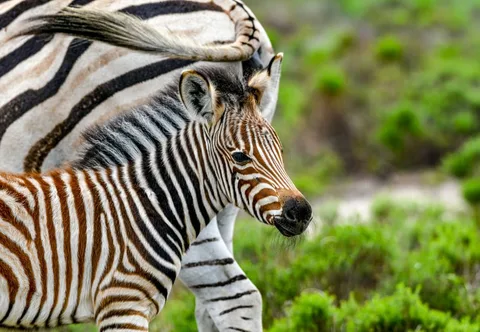
But zebras, giraffes, ostriches, antelopes, hyenas and many more classic safari animals await you here too.

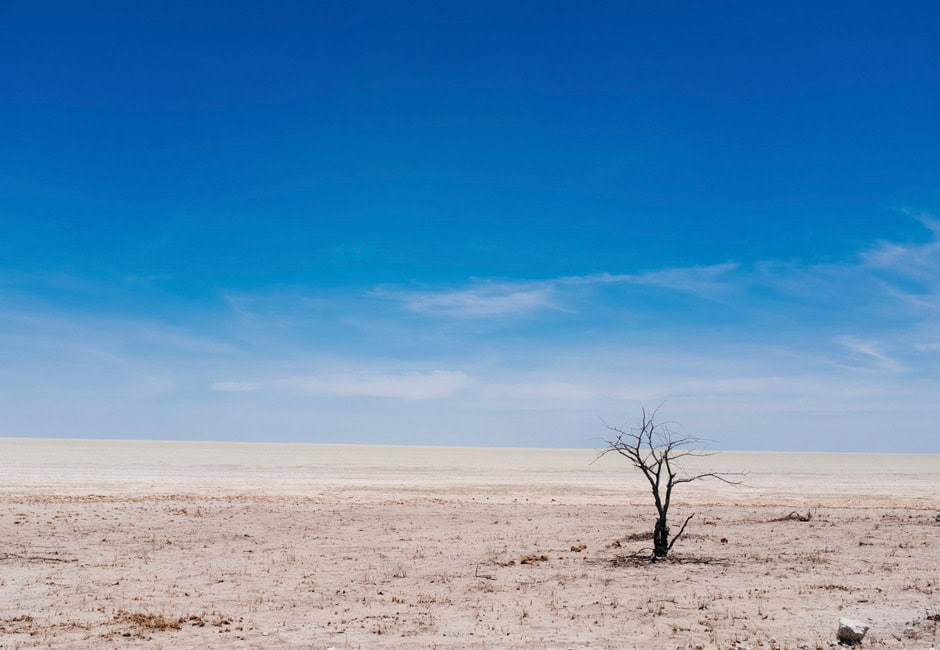
They live on the edge of one of the most fascinating scenic features in the safari world: the Etosha salt pan. Translated, “Etosha” means something like the “great white place” or the “place of emptiness”, and characterises the huge, vegetation-free expanse that alone takes up around 4,760 km2 of the national park's area.
Researchers trace its origin back to a huge lake. This was able to form here via the Kunene River, the border river with Angola to the north, which once flowed in the opposite direction and flushed seawater inland.
After some tectonic and geological influences caused the present flow direction towards the sea, the lake began to evaporate under the heat of the sun and left behind a wide, salty, white expanse.

What looks hostile to life ensures, with its important nutrients, the survival of many animals to this day, which is why you often see them grazing, drinking or licking at the edge of the Etosha Pan.
Water, however, is rather scarce for most of the year today, especially after poor rainy seasons. The park management has therefore set up artificial waterholes, which now supplement those natural groundwater reservoirs that spring to the surface at some points in the park south of the pan and offer permanent drinking opportunities.
What are the temperatures in Etosha National Park?
The semi-arid savannah-desert climate prevailing in Etosha National Park brings maximum temperatures averaging 36°C/37°C in October and reaches its lowest average level in July at 27°C.
It cools down most at night in July. The needle settles slightly below 10°C. The warmest nights reach average temperatures of 19.5°C in February.
In the hot months between October and April maximum temperatures in Etosha often exceed the 40°C mark. Lucky are those whose car has air conditioning. At night in June and July it occasionally even cools down to freezing point.
The months from November to April are also the rainy season, while May to October is the dry season.
The months May to August are generally free of rainfall and are the coolest months of the year.

The best time to travel to Etosha National Park – seasons
When is high season in Etosha National Park?
High season in Etosha National Park largely coincides with the dry season between May and October. This does not change the entrance and accommodation prices in the national park, however; these stay the same all year round. In the lodges around Etosha, by contrast, it is different. There, prices are often adjusted seasonally.
Namibia remains a very popular travel destination, so the accommodation near the country's highlights is very well booked for most of the year. This also applies to Etosha National Park, and especially to the period between July and September. So if you can only travel at this time, book straight away.

The special appeal of the dry season in Etosha lies in the fact that the grass, which grew tall in the rainy season, gets lower and lower, the density of the vegetation decreases markedly and most waterholes quite simply vanish into thin air.
The animals thus become more visible, especially as they concentrate in ever greater numbers at the ever fewer waterholes. African wildlife is served up to you on a plate.
On top of that, it is cooler between May and September and thus considerably more pleasant temperature-wise than the rest of the year, and almost guaranteed rain-free.
Photographers may therefore miss the contrasts that result from the interplay of sun and clouds, dry and wet. But it is nevertheless a photographically interesting time.
The days are shorter between May and September, so the sun sits at a slightly lower angle and offers wonderful morning and evening light. In addition, the cooler nights offer a starry sky with beautiful views of the Milky Way.
Two of our favourite trips including an Etosha National Park safari:
When is low season in Etosha National Park?
Low season in Etosha National Park coincides with the rainy season from November to April. Particularly intense rainfall occurs mainly between January and March. In these months the rain transforms Etosha National Park from a dry, grey and brown-white, dusty landscape into a blooming panorama of lush vegetation.
At these times the rain may soften the sand and gravel tracks and now and then darken or blur your view. As a rule, though, it doesn't spoil your whole day in the park straight away, because it tends to come in episodes.
Want to find out more about Namibia tours?
We'd be happy to advise you. Get in touch!
However, it multiplies the waterholes in the conservation area, so thirsty animals can help themselves anywhere. At the same time, the rain brings denser bushes and taller grasses and makes the animals less visible. So it doesn't exactly make searching for them easier.
In return, you see the landscape with more variety. It is greener, looks more dramatic with its cloud cover, creates exciting contrasts with the penetrating sunlight and, with its water-filled salt pans, attracts pelicans and many thousands of flamingos. It is the season of migratory birds.
And it is the season of antelopes, zebras and other animals that give birth to their young and present them to safari guests.

The best time to travel to Etosha National Park – month by month
Etosha National Park offers exciting specialities all year round with an almost monthly changing menu.
Low season and rainy season
November and December – start of the rainy season
Before the rainy season begins in Etosha in November, it is so dry that even the air is permanently dusty. It is also already very hot. Animals and plants long for the rain.
When the rain then comes, it still holds back considerably. It doesn't fall every day, and often reduces to a heavy afternoon shower or a strong thunderstorm. That leaves you plenty of time in the morning for game drives in the dry.
However, the rain quickly gives the animals a surplus of waterholes, so they can spread out in a relaxed way across the park. As it mostly rains earlier and more in the northern and north-eastern regions of the park, the elephants at this time like to withdraw there.
It is also the first port of call for migratory birds that come here from the winter regions of the northern hemisphere. Much to the delight of bird lovers.
Otherwise, the start of the rainy season is also the start of new life. More and more young antelopes, zebras and other animals see the light of day.
Despite low season , the park can get very busy from mid-December, when the main holiday season begins for the people of the country.

January to March – hot temperatures & persistent rain
Until mid-January it is still holiday season with a lot of movement in the park. After that it gets quiet. Temperatures are regularly well above 30°C. The rain intensifies in these months. Etosha National Park has by now turned green. Lush carpets of grass cover the savannah, dense vegetation fills the bushland.
The rain not only softens the sand and gravel tracks, but also fills the park's salt pans with water. If not already in January, then in February at the latest, areas of the Etosha and Fisher pans can be filled to the point that they attract thousands of breeding-ready flamingo colonies accompanied by pelicans, cranes and storks.
A sight that is still to be had in March too.
April – end of the rainy season
The rainy season is drawing to a close. A slight change in temperature is noticeable. But what does that mean when it is still around 30°C during the day?
Still few people are out and about in Etosha.
The landscapes remain beautiful and rich in contrast. Blue sky and banks of cloud still set the photographic highlights of light. But slowly it is time to say goodbye to the migrating birds.

High season and dry season
May and June – start of the dry season & pleasant temperatures
In May and June, the dry season in Etosha National Park has taken hold. No trace of rain any more. The last migratory birds have left the area. It would now be too cold for them here, given the daytime temperatures falling below 30°C.
At night the needle even drops more and more, to 10°C and below. That promises cold mornings in these and the following months. So wear something warm that you can comfortably take off later without ending up standing there naked.
In May especially, the landscape often still wears the green dress of the rainy season against a backdrop of dense vegetation. At the same time, the roads are easily passable again. Many water sources also remain, which ensures that the animals are spread out.
So for visitors to the park, beyond the open pans and grass plains, it is still a case of: keep your eyes peeled and find the gaps in the bush. But these get bigger towards June, making big game considerably more visible.
Just in time, because in June the rutting season turns into the mating season for many antelope species. Some action is therefore guaranteed that you shouldn't miss.
June in particular is a wonderful time for game drives in Etosha and one of my favourite months for a visit here.
July to September – pleasant temperatures & best time for wildlife viewing
As throughout Namibia, temperatures in Etosha National Park also fall to very pleasant levels before they begin to rise again in September.
The traces of dryness are also already clearly visible: the density of vegetation decreases, the waterholes become fewer, the visible big game more numerous. The country's gravel roads are long since annoyingly dusty again.
As the months July to September are among the best time to travel to Etosha National Park, it is now peak season in the park. People from all over the world stream in. Bookings are recommended at least a year in advance.
Conditions for the wildlife become harsher from month to month in view of the growing number of dried-up waterholes. The residents of Etosha therefore concentrate in increasing numbers at the remaining drinking sources. That of course delights the tourists. For them, spotting these admirable animals becomes ever easier.

October – end of the dry season & fewer visitors
Etosha is now a particularly thirsty land. The months of the dry season are drawing to a close and the streams of visitors are easing off too. In return, temperatures now rise again to the point of being unbearable.
But as long as it doesn't rain in a way that brings more moisture than is immediately soaked up again by the ground, the vegetation and the dry air, the animals can still be found concentrated at the waterholes.
Ideal for you, as a solidly planned waterhole-hopping route is still enough to admire Africa's fascinating wildlife.

My very personal recommendations
My blog “A six-pack of good tips for a visit to Etosha National Park” gives you a lot of useful knowledge to prepare for an Etosha visit.
But when it comes to deciding when the best time to travel to Etosha National Park is, I would like to give you a personal recommendation to take with you.
If you are flexible with your timing, my recommendation would be to visit Etosha National Park in May, June, October or November. For me personally, it is the best time to travel to Etosha. Because in these months you experience a balanced mix of weather, activity levels and good wildlife viewing
For further questions and support with planning your Etosha safari, we are of course happy to help, whether you travel on a guided tour or a self-drive tour.
Thanks to our close contact with our subsidiary in Namibia, we are always well informed about the current situation.
So get in touch! Your dream, our expertise – your very own individual Namibia experience.
Juan Proll has lived in southern Africa since 2011 and works as a certified Nature and Cultural Guide in South Africa, Botswana and Namibia for Elefant-Tours and its subsidiaries. After an earlier career as an adult-education teacher in Germany, he swapped the classroom for the wilderness. Alongside his work as a guide, he writes for the Elefant-Tours blogs about nature, culture and sustainable travel. Juan is a member of the Field Guides Association of Southern Africa (FGASA) and the author of the books “Ich werd’ dann mal Ranger” and “Das Safari-Lesebuch”. The magazine DER SPIEGEL reported on his training.