Etosha National Park – everything you need to know for your trip planning
 by Juan Proll· July 6, 2026· 13 min read· Updated September 10, 2026
Welcome to Etosha National Park – where lions wash the salty taste from their tongues at the waterholes, elephants stroll majestically across the savannah and zebras take dusty spa baths.
Around a gigantic salt pan, Namibia shows its wildest side here – spectacular wildlife viewing, breathtaking landscapes and safari adventures that will have even die-hard homebodies raving.
Where is Etosha National Park?
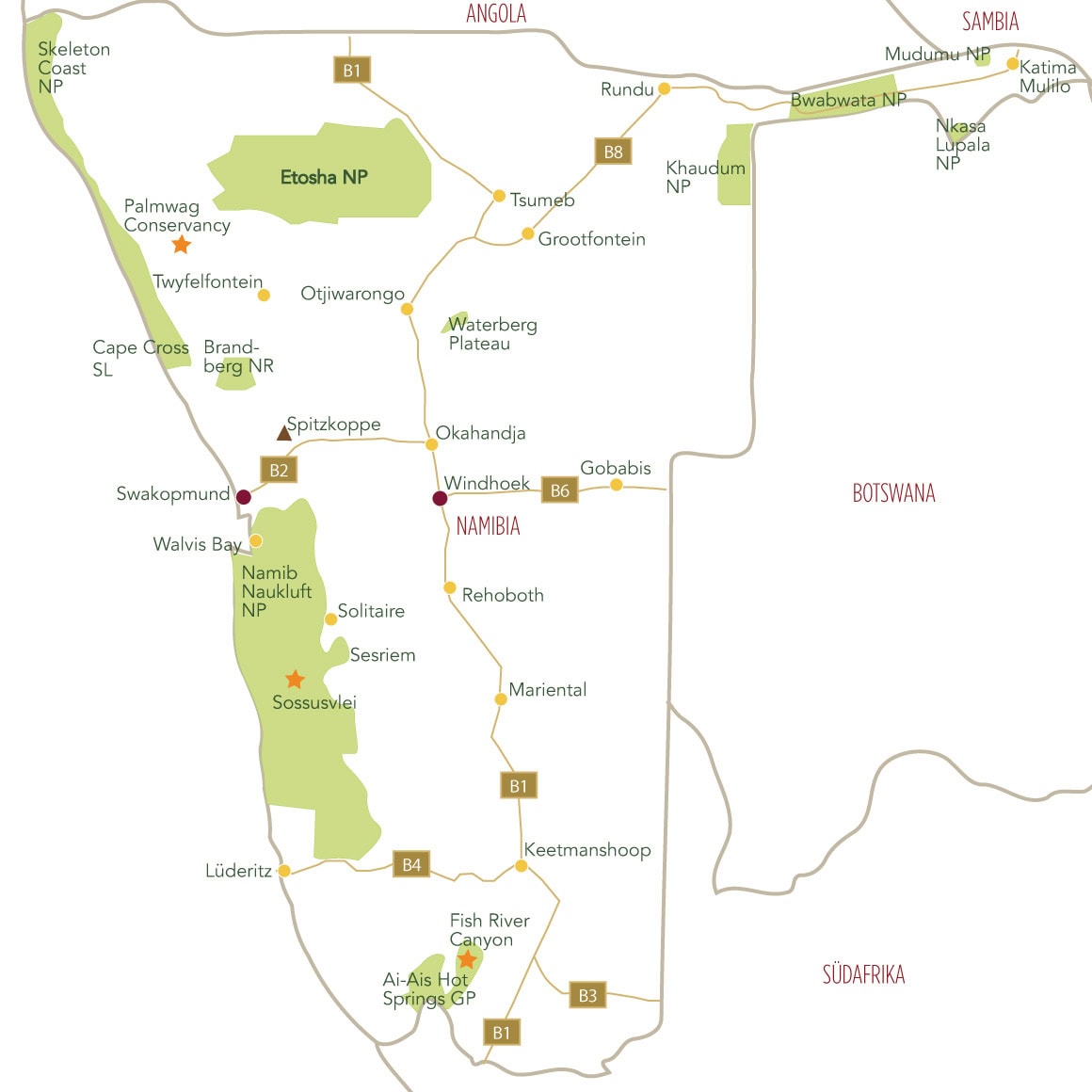
Namibia's legendary safari paradise lies in the north of Namibia and is one of Africa's best-known protected areas. With an area of well over 22,000 km2, Etosha National Park is larger than countries such as Israel or Slovenia and offers endless space for elephants, lions, giraffes, rhinos and countless other wild animals.
Most visitors reach the park via the Andersson Gate in the south, the Galton Gate in the west, the King Nehale Lya Mpingana Gate in the north and the Von Lindequist Gate in the east.
From Namibia's capital Windhoek, the journey by car takes around four to six hours depending on the entrance – enough time to get in the mood for the big safari adventure. Well-built roads make Etosha National Park one of the best destinations for self-drivers in Africa.
What makes Etosha National Park so special?
Etosha National Park combines spectacular landscapes with impressive biodiversity. Thanks to the many open plains and the limited, easily accessible waterholes, wildlife can be observed exceptionally well – animal sightings guaranteed.
The huge Etosha Pan
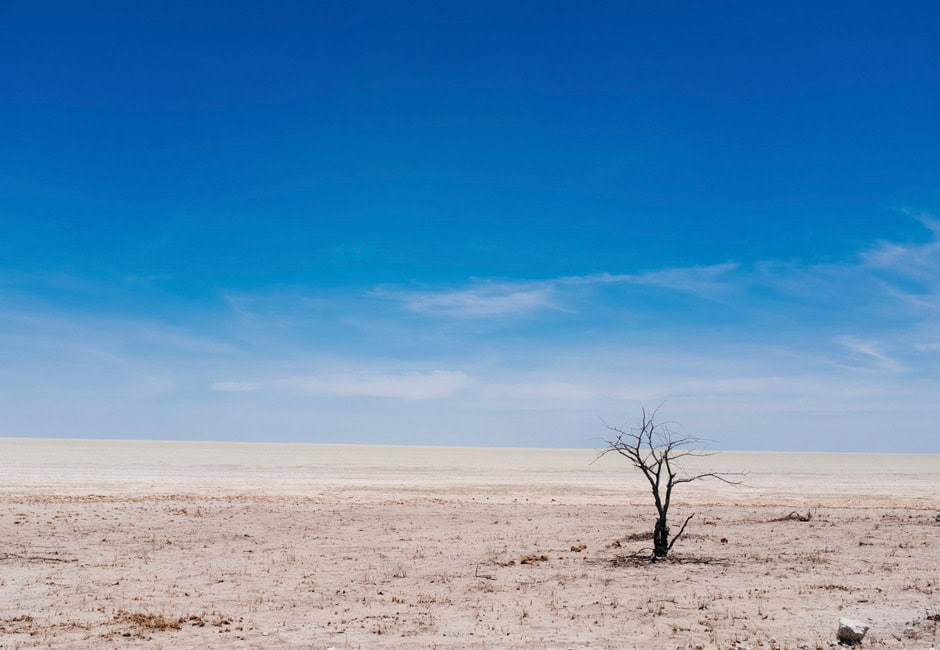
The heart of the national park is the enormous Etosha Pan, a salt flat of around 4,700 km2 that is even visible from space. During the dry season it looks like a huge lunar landscape – white in tone and shimmering slightly greenish under the African sun.
In the rainy season, parts of the pan turn into shallow lakes that attract flamingos and other waterbirds. This fascinating contrast makes the landscape unique and provides photo subjects that are guaranteed not to need a filter.
Waterholes as hotspots for wildlife viewing
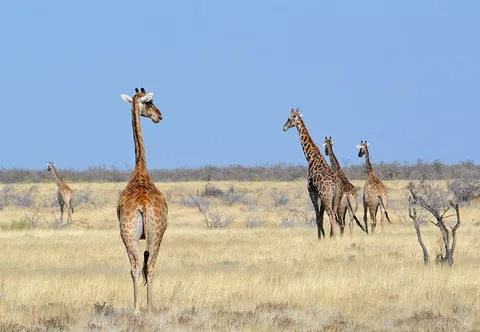
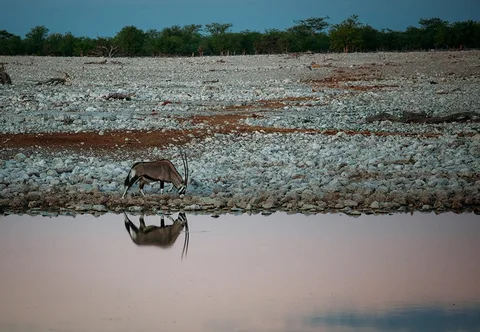
The waterholes are the real stages of Etosha National Park. During the dry season in particular, more and more animals gather here – elephants, zebras, antelope, giraffes and, with a bit of luck, lions or leopards too. Often it takes only a few minutes until the next animal appears.
Patience pays off – and sometimes an exciting spectacle unfolds right in front of your bonnet that makes any TV documentary look dated.

Would you like to find out more about Namibia trips?
We are happy to advise you. Get in touch with us!
What does “Etosha” mean?
The name “Etosha” comes from a word in the Oshindonga language (an Oshivambo dialect) meaning “great white place”, but which can alternatively also be translated as “place of emptiness”, and refers to the Etosha salt pan.
Anyone looking at the huge salt pan for the first time understands immediately why this name was chosen so aptly. The bright, seemingly endless expanse shapes the landscape of the national park and gives it its unmistakable character.
Especially in the dry season the pan glitters in the sun and looks almost like a snow-covered plain. Only you won't see any snowmen here – instead ostriches, oryx, springbok or passing elephants.
The name therefore describes not only the landscape but also the heart of one of Africa's most fascinating national parks.

Which animals live in Etosha National Park?
The Big Five – and which ones are missing
Etosha National Park is one of the best places in Africa to watch large wildlife. Four of the famous Big Five are at home here: elephant, lion, leopard and black rhino. Only the buffalo is missing, as the dry conditions are not ideal for it.
On the other hand, the chances of spotting impressive elephant herds or even rare black rhinos are excellent. The waterholes of the rest camps at Okaukuejo and Halali are, especially in the evening and night hours, the regulars' meeting places for white and black rhinos.
In general, the great safari theatre unfolds daily, especially at the waterholes – sometimes with fear-inspiring lions, sometimes with shy leopards, but very often with elephants bathing in the heat.
Antelope, giraffes, zebras & co.
Besides the famous predators, Etosha National Park delights with an astonishing variety of herbivores. Springbok, oryx, kudu, impala, hartebeest and wildebeest roam the savannah in large herds.
Then there are giraffes, who always keep the best overview thanks to their impressive long necks, and zebras, whose stripe pattern could have come straight from a fashion designer's creative kitchen. Incidentally, in the west of the park you can admire both zebra species found in Namibia: the widespread Burchell's zebra and the rare Hartmann's mountain zebra.
Warthogs also dash through the grass with their tails held high – like an aerial – and regularly raise a smile. This colourful mix makes every game drive varied, because behind every bush the next animal surprise guest may already be waiting.
Birdlife and flamingos
With 400 currently recorded bird species (according to the world bird database “Avibase”), Etosha National Park is a true paradise for bird lovers too. Eagles, vultures, ostriches, colourful rollers and bright bee-eaters are among the common sightings.
After heavy rainfall, parts of the Etosha Pan fill with water and become a meeting place for thousands of flamingos and other waterbirds. The otherwise salt-white landscape then turns into a colourful natural spectacle that never fails to thrill even experienced safari travellers.

The most beautiful regions in Etosha National Park
Etosha National Park can roughly be divided into four safari regions. Each offers different landscapes, animal species and safari experiences. If you spend several days in the park, you should combine different regions where possible.
The south – the classic Etosha safari
The southern part of Etosha National Park is among Namibia's most popular safari areas. Around the southern park gate and Okaukuejo Camp there is a string of well-known waterholes, which, especially in the dry season, are regularly visited by elephants, giraffes, zebras, springbok, oryx and lions.
The open savannah landscape allows excellent visibility and makes this region particularly attractive for first-time visitors. If you are visiting Etosha for the first time, you will often experience impressive wildlife viewing here within just a few hours.
Central Etosha – waterholes and varied landscape
Between Okaukuejo and Namutoni lies central Etosha around Halali Camp. Dense mopane woodland, open grassland and rocky stretches constantly alternate here, creating varied habitats for numerous wild animals.
The region is especially known for its water-rich areas, where elephants, black rhinos, lions and hyenas can be regularly observed. The varied vegetation often leads to particularly exciting and surprising animal encounters.
The east – abundant wildlife and wide plains
The eastern part of Etosha National Park around Namutoni Camp is among the park's richest regions for wildlife. Large plains with numerous waterholes attract enormous herds of zebra, wildebeest, springbok and various antelope species. Dik-diks are also spotted particularly often here.
The herbivores are regularly followed by predators such as lions, cheetahs and hyenas. As the animals are often spread over wide, open areas, the east offers excellent conditions for extended game drives and impressive landscape photography.
The west – wild, unspoilt and little visited
The western part of Etosha National Park is visited far less often than the south or east and offers a particularly unspoilt safari experience. The landscape is drier, more expansive and in many places looks almost untouched.
It is precisely this seclusion that makes the region so appealing. With a little patience you will spot elephants, giraffes, lions, black rhinos and various antelope species here. As far fewer vehicles are on the road, safari guests often enjoy intense wildlife viewing far from the well-known hotspots.
The more luxurious Dolomite Camp serves as an important base for exploring the west. More centrally located is Olifantsrus Camp – popular for its waterhole with a raised visitor platform. But bear in mind: Olifantsrus Camp is small, camping only and quickly booked out.

When is the best time to travel to Etosha?
The answer depends on whether you prefer wildlife viewing or green landscapes, and how much heat you can tolerate. In the dry season the game concentrates at waterholes, while the rainy season brings green savannahs and many bird species.
Dry season
The dry season in Etosha National Park is considered the best time for wildlife viewing. The vegetation is sparse, so wild animals can often be spotted from far away. And the animals gather in ever greater numbers at the ever fewer remaining water points.
This creates spectacular scenes that safari photographers love – the variety and number of Etosha residents present, for example, or elephants claiming exclusivity and chasing other animals away. Predators also benefit from the concentration of prey and are easier to observe than at other times of the year.
Rainy season
The rainy season transforms the Etosha National Park into a green, lively landscape. After heavy rain, the Etosha Pan partially fills with water and attracts numerous waterbirds.
Particularly impressive is the spectacle of the flamingos, which appear in large flocks and colour the landscape pink. Young animals are also born more often now, as there is plenty of food.
Wildlife viewing is more difficult, as the animals spread out further and the dense grass offers more hiding places, but the landscape is especially photogenic and alive.
Popular tours:
Safari in Etosha National Park – self-drive or guided tour?
In Etosha National Park you can decide for yourself how you go on safari: completely flexibly in your own car, or comfortably with an experienced guide in an open vehicle or in a Land Cruiser with a pop-up roof and panoramic views. Both options have their charm and deliver unforgettable wildlife moments.
Self-drive
As a self-driver in Etosha National Park you are your own safari guide: stopping whenever an elephant models or a lion poses in the middle of the road is expressly allowed. You also choose the route yourself. You decide pace, route and breaks – pure freedom.
The well-built roads and clear routes make orientation easy, even for safari newcomers. A special bonus for our self-drivers: if you book two nights in Etosha through us, a free game drive in an open safari vehicle with a guide is already included.
That way you get professional insights on top, without having to give up your self-drive adventure – the perfect combination of freedom and expert knowledge.
Guided game drives
Guided game drives in Etosha National Park are ideal if you want to sit back and relax and still enjoy full safari expertise.
Experienced guides know the best spots and the behaviour of the animals – so a bush quickly becomes a lion's hideout or a dust cloud an elephant family. In an open 4×4 you also get perfect all-round views and have nothing to worry about except your camera.
The stories and knowledge of the guides, who have often spent years in the park, are especially fascinating. Every drive thus becomes not just wildlife viewing but also a small safari expedition with insider knowledge and surprising moments.

Practical tips for your visit
A few practical tips will make your visit to Etosha National Park even more relaxed. From opening times to rules of conduct to the right equipment – if you start out prepared, you will experience the safari far less stressfully and with more happy wildlife moments.
Opening times & entrance fee
Etosha National Park generally opens at sunrise and closes at sunset, as night drives are not allowed. By the strictly set closing times you must either be in camp or have left the national park.
The exact times vary depending on the time of year and are posted at every entrance gate to Etosha Park and at the entrance to every overnight reception within the park.
A daily entrance fee per person and vehicle is charged at the gate. For foreign guests it is currently (2026) N$280 for entry plus N$60 for a car.
Behaviour in the park
The following applies in Etosha National Park:
- The animals are the stars, we are just spectators.
- Always stay in your vehicle, except at designated places
- Keep a sufficient distance from the wildlife – however photogenically an elephant may pose.
- Feeding is strictly forbidden, as it changes the animals' natural behaviour and can become dangerous.
- Drive slowly, watch for dust clouds and use waterholes as observation points.
Patience is your best safari companion: often nothing happens for minutes, and then suddenly everything at once. Calm, respect and a good eye are the key to unforgettable moments in the park.
Packing list
For Etosha National Park you should pack light, but smart. Essentials: binoculars for wildlife viewing, a camera with a zoom lens and plenty of storage space.
Comfortable clothing in neutral colours helps you avoid standing out unnecessarily, and a jacket is sensible for cool morning drives. Sun protection, a hat and sunglasses are a must, as is enough water for the road.
Snacks for long game drives and a means of navigation are handy. Dust protection for your camera and luggage is also sensible, as the roads are often dry and dusty. That way you are well equipped for any safari adventure.

Frequently asked questions about Etosha National Park
How big is Etosha National Park?
According to its own figures, Etosha National Park is 22,912 km2 in size. Its heart is the famous salt pan, which alone covers 4,731 km2 of the area and, seen from space, looks like a giant white plate.
Which animals can you see in Etosha National Park?
Etosha National Park is home to over 100 mammal species and, seasonally, up to 400 bird species – a true all-inclusive offering for safari fans. Elephants, lions, rhinos, giraffes and zebras are especially well known, regularly posing at the waterholes as if they had booked a permanent engagement there for nature documentaries.
Ostriches, springbok and jackals are also frequently seen. With luck you might even spot a leopard in the undergrowth. The birdlife ranges from majestic eagles to shrill groups of flamingos dressed in pink, which are spectacular to watch especially at sunrise and sunset.
Is Etosha National Park suitable for self-drivers?
Yes, Etosha National Park is excellently suited to self-drivers – well-maintained gravel roads, clear signposting and many waterholes make navigation easy. But bear in mind: animals always have right of way. Especially handy: you drive at your own pace and stop when the wildlife takes the stage.
Please note: if you book your self-drive trip with us and stay at least 2 nights, you get a game drive in an open safari vehicle with a guide included – ask our travel experts about it. This makes the trip especially flexible and unforgettable for all guests.
How many days should you plan for Etosha?
You should plan at least two nights, if only to get a game drive in an open safari vehicle with a guide included from us, unless you are already on a guided tour.
As a rule, you should plan about 3 to 5 days for Etosha National Park to explore the different regions at a relaxed pace. If you stay just one day, you will see animals, but rather in fast-forward – like a safari snack instead of a proper buffet.
With several days, the chance of exciting encounters at different waterholes rises significantly. You can also spread out your wildlife viewing and don't have to rush after every elephant. That makes the trip much more relaxed and more intense.
Can you see the Big Five in Etosha National Park?
Of the famous Big Five, Etosha National Park has at least the Big Four. The buffalo are missing. Elephants, lions and rhinos can often be observed well, especially at the water points. Leopards are present, but very shy and more masters of camouflage than of showmanship.
What accommodation is there in Etosha National Park?
Etosha National Park has a good mix of state-run rest camps and private lodges. Inside the park, Okaukuejo, Halali and Namutoni are the best-known camps – with simple to comfortable accommodation and, in Okaukuejo, even a direct view of the floodlit waterhole. In the west lies the luxurious Dolomite Camp.
More luxury can be found outside the park. There you will find countless lodges and guest farms. Also well suited for anyone who, after the safari adventure, would rather relax in the pool than in the sand.

Why Etosha National Park belongs on every Namibia trip
Etosha National Park is not a “nice to do” on a Namibia trip – it is a genuine must-see with a goosebump guarantee. No other place in Namibia delivers spectacular wildlife viewing in such a unique landscape so reliably.
The combination of the huge, surreal-looking salt pan, the numerous waterholes and the enormous wildlife density makes every visit a safari highlight. You don't have to search for long here – the animals often just come by on their own.
Whether majestic elephant herds, giraffes trotting elegantly or big cats in perfect pose: Etosha delivers nature cinema in real time. Add to that the easy accessibility and good infrastructure, which make it ideal for self-drivers.
If you really want to experience Namibia, you can't bypass Etosha. It is this mix of wilderness, vastness and “wow moments” that makes the park an unforgettable centrepiece of any trip – a legendary safari paradise that is guaranteed to deliver adventures you will be telling stories about for a long time.
If you are tempted by the Etosha region after this blog, I understand only too well. We are happy to help with any questions and with further support in planning your Namibia trip, whether on a guided group tour, a guided private tour or a self-drive tour.
Etosha National Park is definitely worth it. And thanks to our close contact with our subsidiary in Namibia we are always well informed about the current situation. So get in touch with us! Your dream, our expertise – your very own Namibia experience.
Juan Proll has lived in southern Africa since 2011 and works as a certified nature and cultural guide in South Africa, Botswana and Namibia for Elefant-Tours and its subsidiaries. After an earlier career as an adult education teacher in Germany, he swapped the classroom for the wilderness. Alongside his work as a guide, he writes for the Elefant-Tours blogs about nature, culture and sustainable travel. Juan is a member of the Field Guides Association of Southern Africa (FGASA) and author of the books “Ich werd’ dann mal Ranger” and “Das Safari-Lesebuch”. The magazine DER SPIEGEL reported on his training.