Damaraland in Namibia – Your Guide to Nature, Culture & Adventure
 by Juan Proll· May 13, 2025· 16 min read· Updated September 30, 2026
Discover fascinating Damaraland in Namibia – a place full of breathtaking nature, rich culture and exciting adventures! From impressive rock formations and ancient rock paintings to wild animals.
A trip awaits you here that will make your heart beat faster. You'll find your ultimate guide to nature, culture and adventure in Damaraland in today's blog.
Why Damaraland belongs on your Namibia trip
I call Damaraland in Namibia a desert-like paradise. I love it for its barren but spectacular landscape, for its wildlife that defies hostile conditions, and for its overwhelming cultural heritage.
I'm fascinated by the thought that Stone Age ancestors of the San once roamed this area, left behind tens of thousands of rock drawings and engravings, and hunted the native wildlife in the struggle for survival.
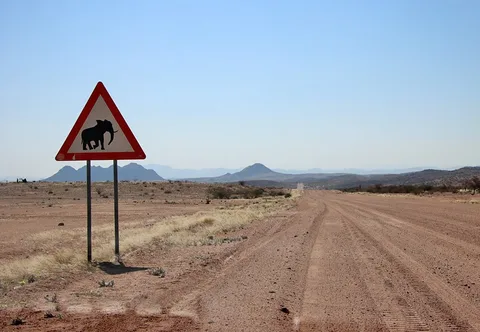
It's hard to believe that, right in the middle of this open wilderness, desert-adapted animals still live today, including elephants, lions, rhinos, giraffes and zebras.
Damaraland is of such bizarre beauty and natural wildness that it exerts a magical pull on adventure seekers, culture lovers and wildlife enthusiasts alike.

Why Damaraland is called “Damaraland”
You won't find a Damaraland with cartographic boundaries on any current map. The reason: during South African apartheid, “Damaraland” was the name of a designated homeland for the Damara people.
All Damaras who lived elsewhere in Namibia (then “South West Africa”) were forced to move to this area, which, at 47,990 km2 , was larger than the national territories of the Netherlands or Switzerland.
With the end of apartheid in Namibia in 1989, this nightmare was over too. Damaraland was now administratively assigned partly to the Erongo Region and partly to the Kunene Region.
Nevertheless, the name “Damaraland” has persisted stubbornly and today, from a tourism perspective, has been given a “positively intended” reinterpretation, from “homeland” to a “highly attractive tourist landscape region”. Besides, it is no longer only Damaras who live here.
Where is Damaraland in Namibia? – Getting there & location
Since 1990, Damaraland has no longer been an official designation and therefore has no administrative boundaries. The name refers to the homeland of the same name from the apartheid era.
It bordered the Namib Desert (Skeleton Coast) in the west, ended in the south at the B2 near Arandis and in the north merged into the Kaokoveld at the level of Sesfontein and the Hoanib River.
In the north-east it touched the south-western corner of Etosha National Park and ran roughly via Kamanjab, the Ugab Valley with the well-known Vingerklip formation and the Erongo Mountains to the B2 near Karibib in the south-east.
Etosha National Park is best reached from Damaraland via the entrance gates of Galton Gate to the west and Anderson Gate, accessible from the south.
The Skeleton Coast to the west of Damaraland can only be reached via a few roads in poor condition. Among them are the C35 from Uis and the C39 near Bergsig.
You can reach the Kaokoveld comfortably via the C43 heading north. Together with the C39, it is the main artery of Damaraland.
In addition, there are a whole series of tracks going in all directions, but they are especially popular heading towards the coast and along the dry riverbeds because of their wildlife. If you are travelling here as a self-driver, you should plan for a number of safety precautions.
Because getting stuck in the very sandy ground or getting lost despite GPS is not uncommon. Mobile phone reception is also non-existent over long stretches.
A guided tour with a guide at your side is therefore recommended. Guides know the land, the difficult terrain, the deep sand, the people and the animals, including their behaviour, very well.
And with a guide you have a team behind you that is very experienced, from the organisation office right down to the vehicle workshop. Especially when it is the team of our subsidiary on the ground in Windhoek.

A drive through spectacular landscapes
A drive through the vastness of Damaraland in Namibia is an experience in itself because of its arid, desert-like landscape.
The people here will tell you that the land is too dry and the rain too unreliable. You quickly understand the importance of drilled water wells and productive natural springs for surviving under these conditions.
Only a few people live here. They work the communal farmland with chickens, sheep, goats, a few cattle and modest gardens. This is the only way they can secure at least a meagre living.
Time and again you see wildlife roaming. More often elephants, giraffes, zebras, kudus, oryx or ostriches. Lions or leopards, by contrast, are seen less often.
They all live in a tremendously beautiful landscape. The views along the way are spectacular. Sandstone formations mix with reddish shimmering basalt uplands and granite massifs. Inselbergs form exciting contrasts with the table mountains.
Vast, barren plains lie between mighty dry river valleys. Here and there, stands of mopane and acacia trees, endemic Euphorbia damarana shrubs and the venerable desert plant Welwitschia mirabilis join them. Together they shape the special character of this natural setting.
Would you like to find out more about Namibia trips?
We'll be happy to advise you. Get in touch!
What can you do in Damaraland? Highlights you shouldn't miss
Damaraland offers all travellers a great combination of scenery, wildlife and culture. Believe me, you can't be disappointed.
You may see more or fewer animals at any given time. But what remains reliable are the breathtaking natural panoramas, the at least fleeting encounters with the Damaras, Hereros and Himbas, and the awe-inspiring encounters with rock art up to 6,000 years old.
On most round trips in Namibia, Damaraland lies on the route from Sossusvlei via Swakopmund to Etosha National Park. Along the way you pass a series of sights in Damaraland, such as the following:
Spitzkoppe – the Matterhorn of Namibia
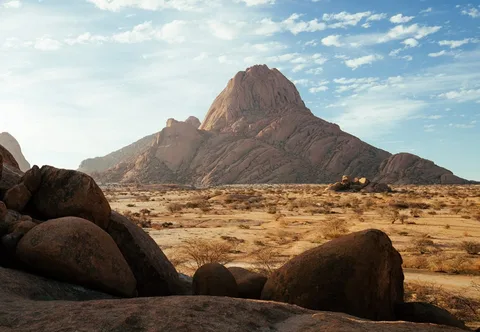
A feast for the eyes is on its way even from afar. First you see the Erongo Mountains, where you can enjoy great hikes. But then you drive towards the Spitzkoppe, an inselberg above an endless plain. Every metre you get closer is like a revelation.
This impressive granite formation is often called the Namibian Matterhorn. At 1,728 m, the Spitzkoppe is nowhere near as high, but similar in shape.
You can find more about the Spitzkoppe in my blog “The Spitzkoppe in Namibia: Is it worth a visit?”

Brandberg – home of the “White Lady”
At approx. 2,573 m, the Brandberg is Namibia's highest mountain. But more impressive than its appearance are the roughly 43,000 rock paintings immortalised there, which are about 2,000–4,000 years old. They are attributed to the nomadic San peoples of that time.
The most famous drawing among them shows the so-called “White Lady”, who is actually a man. More precisely: a “shaman”.
Petrified Forest – organic life turned to stone
Impressive in a different way is the Petrified Forest near Khorixas. Here you can discover petrified tree trunks more than 250 million years old.
Vingerklip – a rock in the surf
If you have time for another detour, I recommend the Vingerklip Lodge in the Ugab Valley. Here you enjoy magnificent views of a terraced landscape and a true tourist attraction: the roughly 35 m high Finger Rock.
This needle of sedimentary rock towers over the plain like a memorial reminding us of the destructive forces of nature, which it itself only narrowly survived: a true rock in the surf.
Twyfelfontein – UNESCO World Heritage site of rock engravings in Damaraland, Namibia
Twyfelfontein is the temple of rock engravings carved into sandstone. Here, ancestors of the San peoples created works of art over generations that date back approx. 6,000 years.
It is hard to believe that they are so well preserved, given the forces of natural erosion and the arbitrary human willingness to destroy.
In 2008, Twyfelfontein with its rock art was declared a UNESCO World Heritage Site. It is the engravings in the softer sandstone that distinguish them from the drawings in the harder granite at the Brandberg and the Spitzkoppe.
The special protected status allows you access only with a guide. You are automatically assigned one at the visitor centre when you buy your ticket. There is also a small exhibition on the history here.
A certain level of fitness is recommended. There are no paved paths, but there are uneven stone steps. Shade is also scarce. And it can get very hot. But: don’t miss it!
You can read more about Twyfelfontein in my blog “Is Twyfelfontein in Namibia worth it?”.

Damara Living Museum – Organ Pipes – Burnt Mountain
If you visit Twyfelfontein and bring a little more time as well as additional interest, you can take in more great experiences nearby.
For example, the Organ Pipes bear witness to volcanic activity in this region. With their angular, vertically rising basalt columns up to 5 m high (dolerite), they are reminiscent of organ pipes.
Just a few metres further on lies Burnt Mountain. It really does look a bit like a burnt chicken in the oven. For it was magma at around 1,000° C that settled over organic material here and charred it.
The Damara Living Museum offers insights into the traditional culture of the Damara. It is the only “living” museum in the country where you can learn about the customs and traditions of the Damara people.
Palmwag – Etendeka – Grootberg – a true landscape experience in Damaraland, Namibia
The first tourism concessions were issued in the Palmwag, Etendeka and Grootberg area. They allowed the people of the region to create the necessary infrastructure to open the way here for travellers. For the local residents, it meant from then on the chance to benefit economically from tourism.
It goes up and down here. The landscapes seem to come from another world: red basalt rock, cone-shaped and table mountains, wild gorges, barren expanses and, in between, wild animals again and again.
Wildlife in Damaraland in Namibia – between desert and wilderness
Encountering large game outside national parks in a shared habitat with people is becoming increasingly a great rarity worldwide. In Damaraland, it is possible.
Here giraffes, zebras, kudus, springbok and the like live, but also cheetahs, leopards, rhinos, lions and elephants still in complete freedom. This isn't always free of conflict, but the willingness on the part of the residents is clearly noticeable.
Lions and elephants in particular have had to get used to the harsh, desert-like conditions. The rhinos of the region also face greater challenges than their counterparts in Etosha National Park.
This makes Damaraland, with the adjoining Namib Desert, the only place in the world where, alongside black rhinos, you can also encounter desert elephants and desert lions.
Tourists passing through almost always see some animals, but not quite so reliably the giraffes, zebras, rhinos, lions or elephants.

That is actually easier in Etosha National Park. You can find more about Etosha's animals in my blog “Which animals are there in Etosha National Park?”.
In Damaraland you need good local knowledge to know where the animals are often found. Another reason to join a guided tour with a guide.
Rhinos – living in seclusion
The rhinos in this region are exclusively black rhinos. Damaraland is home to the world's largest free-roaming black rhino population.
They are mainly browsers and, unlike white rhinos, do not depend so much on grass, which grows here at best after rain. Trees with nutritious leaves, by contrast, are far more plentiful.
In this area they also eat the euphorbia shrubs, which are poisonous to us humans and many other animals. A result of their adaptation. As is the ability to withstand large temperature swings from below zero to plus 40 degrees Celsius.
They are also more nocturnal than rhinos in other habitats. And, unlike usual, they manage to survive for up to four days without direct access to water.
However, they live very secluded lives and are therefore best discovered on dedicated rhino tracking tours.
Desert lions – seal is on the menu too
A painstakingly conducted count of the lions in Damaraland and the adjoining Namib Desert in 2023 showed that we can reliably assume around 70 desert-adapted lions.
However, these are spread from the Brandberg to Sesfontein over an area roughly the size of Switzerland.
Finding them is by no means a given, even for local guides. And yet an astonishing number of missions end successfully here too.
Desert lions often look noticeably leaner than their counterparts in Etosha. When they can, they help themselves to the farmers' livestock.
One of the most extraordinary adaptations of these lions, however, is this: they walk – unique in the world – across the sand dunes of the Namib Desert to the coast of the Atlantic Ocean and feed on seals there.
My blog “Seals as far as the eye can see” tells of the seals at Cape Cross.
Desert elephants – rare encounters in the dry riverbed in Namibia's Damaraland
Desert elephants may be easier to spot, but their numbers can't always be determined reliably either. It is currently estimated that between 80 and 150 desert-adapted elephants live in Damaraland.
Once again, few for a huge region. Once again, many nevertheless get lucky. Anyone who wants to be reasonably sure of seeing them takes part in an elephant tracking tour.
Compared with the savannah elephants found elsewhere, desert elephants have, among other things, longer walking distances between food and water sources; flatter soles that give them more footing in the sand (snowshoe effect); longer periods without water of up to 5 days; and on average smaller herds. No wonder, then, that they also look slimmer.
You can find more info in my blog “Where can you see desert elephants in Namibia?”.

My top 10 wildlife sightings in Damaraland in Namibia
Beyond the desert elephants, desert lions and desert-adapted black rhinos, there is a long list of other exciting animals in this region. Unfortunately, their numbers depend very heavily on the dryness each year. Here is my top 10:
- Giraffes: In this wasteland they seem even more impressive with their size, because trees and shrubs are often much smaller.
- Hartmann's mountain zebras: These are zebras that you rarely see in other southern African regions. They differ from plains zebras in having a white belly, a dewlap and no brown “shadow stripes”.
- Oryx: This is how you imagine a spearbuck: menacing, straight, pointed horns over 90 cm long. They are true desert specialists.
- Springbok: Always lovely to watch when they perform their springbok ballet. And they obviously can't be killed off, even in the greatest heat.
- Meerkats: For this super-cute species of mongoose you really need a lot of luck, and you should also be prepared to brake hard along the way. Not because they stand in the way, but because they suddenly and unexpectedly appear at the side of the road.
- Ostriches: Their brain may be smaller than their eye, but I still find seeing them exciting every time.
- Leopards: They also require some luck, but what a beautiful cat!
- Klipspringers: They are true mountain specialists and walk on tiptoe like prima ballerinas.
- Kudus: The males' horns are magnificent, the females' ears enormous. Either way, real eye-catchers.
- Guineafowl: Somehow beautiful birds, but they run excitedly ahead of your vehicle for 200 m until they remember they can fly too. Simply funny every time.
Two of our favourite trips with a visit to Damaraland
Where in Damaraland can you find the most animals?
As already said: if you keep your eyes open, you'll find plenty along the main road. This is especially true on the stretch between Twyfelfontein and Palmwag.
But the route up to the Grootberg Pass also offers great surprises time and again. Along the main roads I have already seen all the animals I mentioned above.
But if you want to switch to adventure mode and see even more of this great wildlife, then I recommend the dry riverbeds.
You could try the Aba-Huab River in the hinterland of Twyfelfontein, for example. Likewise the Ugab River around the Brandberg. Or the Hoanib River near Sesfontein.
But beware: 4×4 is a must! You keep running into deep sand.
And sometimes you feel so alone that even a single elephant, let alone a herd, suddenly triggers very uneasy feelings.
But above all because of the untouched nature of these areas and the danger of getting lost quickly, I recommend guided tours with a guide here. This applies especially to the Hoanib dry riverbed, where a guide allows you to go much further into the Namib.
You can find more about the Hoanib River valley in my blog “My favourite places in Africa – the Hoanib Valley”.
Popular and more relaxed for self-drivers is also the Palmwag Concession Area. The best way to find out how many animals are there when you happen to pass through is to ask the rangers at Palmwag Lodge. They regularly drive in there with guests.

Best time to travel to Damaraland – weather & climate
Although Damaraland looks hostilely barren for most of the year, in the rainy months from November to April it can take on lush green colours.
If a lot of rain falls, even the dry riverbeds fill and the landscape is once again spectacular in a completely different way. So you are welcome to come here all year round.
The dry season lasts from May to October and is considered the best time to travel. The drier it is, the better your chances of watching wildlife at the waterholes and dry riverbeds.
In contrast to the generally very hot rainy months, temperatures in the dry months – at least until September – are pleasantly warm during the day.
However, it cools down considerably at night. That invites you to snuggle up under the duvet. All in all, it is certainly understandable why this season is a very popular one for travellers to Damaraland. Even though prices are higher than in the low season.
Accommodation in Damaraland in Namibia – from camping to lodge
Basically, in Damaraland you have a wide choice of accommodation. There are spectacular, luxurious tented camps in unspoilt nature, lodges with magnificent panoramic views, guest farms where you are welcomed like a member of the family, and campsites with all the comfort you could wish for.
But bear in mind: Damaraland has now become a very popular destination. In addition, the Palmwag-Etendeka-Grootberg area is a real bottleneck on the way to Etosha National Park.
If you want to be on the safe side with places to stay here, you should easily book a year in advance for peak season periods.
The Grootberg Lodge in particular is extremely popular. Understandably, because the view over the Klip River Valley is simply breathtaking.
If you would like to spend longer in the Twyfelfontein region, then, for example, the Malansrus Tented Camp is recommended for its special location and luxurious flair.
For more great accommodation, just ask my colleagues at Elefant-Tours.

How much time should you allow for Damaraland?
Damaraland in Namibia is a fascinating region with a lot to offer, from impressive landscapes to unique wildlife and cultural highlights. For a worthwhile visit I would allow 3 to 4 days.
That gives you enough time for the most important sights such as the granite formations and rock paintings of the Spitzkoppe, the White Lady at the Brandberg and the rock engravings at Twyfelfontein.
It also gives you enough opportunity to admire the breathtaking landscape and experience the region's unique wildlife. A rhino or elephant tracking tour would also be possible.
If you have more time, all the better. Then you might also be able to take a guided hike or multi-day tours into the wilderness to discover Damaraland even more intensely.
All in all, it's worth setting aside a little time to really enjoy the beauty and diversity of this unique region!
Personal verdict – why Damaraland in Namibia is a highlight for me
For me, Damaraland is a true jewel in the heart of Namibia that enchants me again and again with its breathtaking landscape, its extraordinary wildlife and its fascinating history.
Here endless, desert-like expanses merge with majestic rock formations into a romantic panorama that simply touches my heart.
The quiet beauty of this place invites you to let your soul unwind and experience unforgettable moments – whether watching the sunsets, admiring the legendary starry sky, exploring the ancient rock paintings or marvelling together at the wild animals.
Damaraland is not only a place of natural wonders, but also a place that unites the love of nature and the magic of the moment in a unique setting. A real highlight that takes the hearts of all travellers by storm.
We would be delighted to welcome you to this beautiful country of Namibia and fascinating Damaraland. For any further questions and support with planning your Namibia trip, we are happy to help.
Thanks to our close contact with our subsidiary in Namibia, we always know the current situation well. So get in touch! Your dream, our expertise – your very own individual Namibia experience.
Juan Proll has lived in southern Africa since 2011 and works as a certified nature and cultural guide in South Africa, Botswana and Namibia for Elefant-Tours and its subsidiaries. After an earlier career as an adult education teacher in Germany, he swapped the classroom for the wilderness. Alongside his work as a guide, he writes for the Elefant-Tours blogs about nature, culture and sustainable travel. Juan is a member of the Field Guides Association of Southern Africa (FGASA) and the author of the books “Ich werd’ dann mal Ranger” and “Das Safari-Lesebuch”. The magazine DER SPIEGEL reported on his training.