When is the best time to travel to Chobe National Park in Botswana?
 by Juan Proll· January 27, 2025· 13 min read· Updated May 23, 2025
Chobe National Park in Botswana stands for breathtaking nature and wonderful encounters with wildlife. The Chobe River, which attracts vast numbers of animals and travellers every year, and the far more remote and peaceful Savuti region in the west of the park are the main attractions. But when is the best time to travel to Chobe National Park?
The best time to travel to Chobe National Park at a glance
Without doubt, the Chobe National Park, covering around 11,700 km2, is one of Africa's most spectacular safari destinations. In this paradise for people and animals, the Chobe River section, with its abundance of wildlife in and along the river, and the Savuti marshland, with its migrating herds of zebra and wildebeest and lions specialised in hunting elephants, stand out in particular for tourism.
Rainy and dry seasons in a warm to hot climate influence life throughout Chobe National Park. As a general rule: the drier, the better, because wildlife sightings are all the easier.
The dry season in Chobe National Park lasts from April to October. This period also includes the coolest months of the year, from May to August.
The rainy season in Chobe National Park lasts from November to March. It rains most in January and February.
Chobe National Park offers a year-round safari experience. But many consider the time between May and September to be the best time to travel to Chobe National Park. Then it is dry, not too hot, and most animals gather at the easily accessible Chobe River. Safaris here create unique memories on land and on water.

The best time to travel to the Savuti region in Chobe National Park
The Savuti region is something of a special case here. Although it is a marshland, it is at times very dry and only blossoms after good rainy seasons. Only then are many animals there too, and you can witness the large herds of zebra and wildebeest migrating here.
On this condition, the best time to travel in the Savuti region is March and April. At this time it no longer rains as extremely as in January and February. Especially towards April, road conditions become manageable again even for an off-road vehicle, and the migrating zebras and wildebeest are still in the area.
Our favourite safaris in Chobe National Park in every season:
The best time to travel to Chobe National Park – seasons
When is high season in Chobe National Park?
Although the dry season rules in the months from April to October, high season in Chobe National Park falls in the colder period from May to September. In these months temperatures still rise to 25°C, but at night they fall to below 10°C at the extreme.
With the start of the dry season, water dwindles in many other parts of the country. This leads to animal movements towards Chobe National Park, where there is still plenty of water. More and more animals, especially elephants, are therefore drawn here.
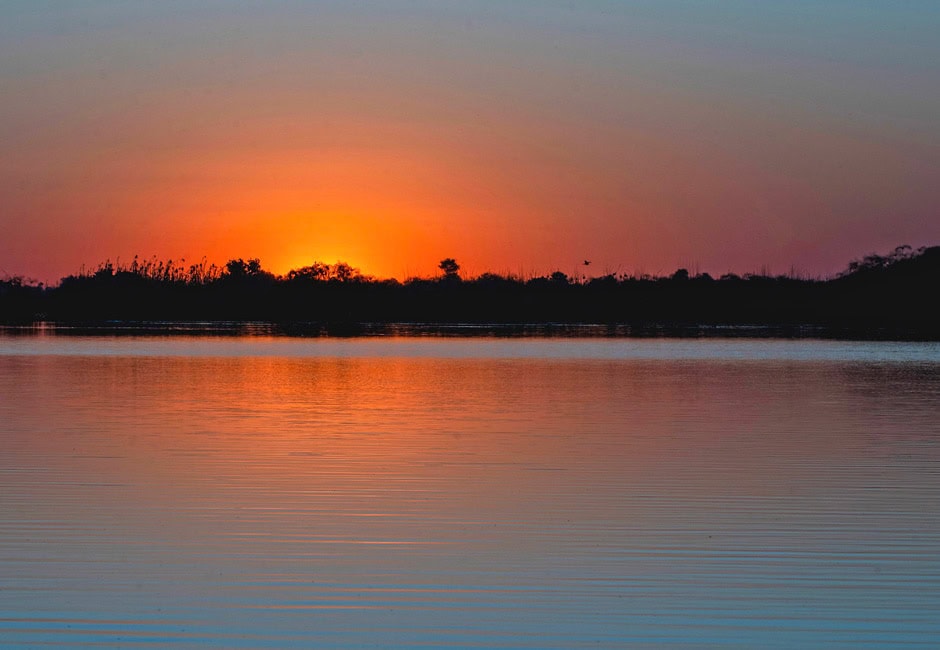
As rain-free sunsets become more frequent and the numbers of wildlife along the banks and in the water rise, boat trips become increasingly romantic.

When is low season in Chobe National Park?
Low season in Chobe National Park coincides with the country's rainy season from November to March. Overall, it means that driving on the wet, sandy and muddy tracks becomes ever more difficult and in places is not possible at all without four-wheel drive.
On the other hand, in November through to December you can also be lucky, and the rain misses its scheduled start. Then, although you are travelling in the low season, you still have – apart from the extreme heat that is usual in this month – very good chances of seeing many animals drinking at the river.
You can have similar luck in the supposedly wettest phase of the rainy season. When it rains so little in January and February that you can drive through Chobe National Park well in an off-road vehicle and even see beautiful plants and lush greenery along your route.
Discover Botswana with us.
Get in touch!
When do you see the most animals in Chobe National Park?
As the dry season progresses, most animals gather in the Chobe River region and only leave for other parts of the country with the start of the rainy season. That means you see the most animals in Chobe National Park particularly between May and October.
In the Savuti region, on the other hand, you see the most animals between January and March, when in good rainy-season years the large migrating herds of zebra and wildebeest move here.
However, since very many routes are then very difficult or impossible to drive, the best time to travel in the Savuti marshland is March and April. Then road conditions are significantly better thanks to the easing rain, and you can still see plenty of animals.

When is the best time to travel for boat trips on the Chobe River?
The best time to travel for boat trips on the Chobe River is the months between May and September, when the rest of the country threatens to dry out and the animals here in and along the water still have a reliable drinking source. At the same time, temperatures are pleasant.
In October, many animals can still line the river and the bank areas, but this month is already very hot again.
By contrast, April is a month that takes over from the rainy season. At this time the landscape is still very rich in vegetation and many grasses are tall. This makes it harder to see the animals living here. The seasonal influx of many animals caused by the dry season only happens later. Despite this limitation, April is a very beautiful month for boat trips, especially for the scenery.

The best time to travel for other highlights in the region: Okavango Delta and Victoria Falls
In the blog Best time to travel to Botswana you will find plenty of information about the varying seasonal conditions across the country. They show that at certain times there are exciting combinations between a visit to Chobe National Park and other sights in the region.
Best time to travel for Chobe National Park and the Okavango Delta
The months July to September are among the best times to travel to combine Chobe National Park with the Okavango Delta.
This is because the best time for big-game viewing in the Okavango Delta is in the dry months from July to October, when particularly plentiful water can be found here while it is badly lacking elsewhere.
It is not the rainy season that makes the delta flood, but rainwater from the distant Angolan highlands, which reaches the Okavango basin with a time delay in Botswana's dry months and only seeps away more and more there towards October.
Until then, breathtaking natural landscapes, countless waterways with their opportunities for mokoro trips and huge numbers of animals make for the best Okavango safaris.

Best time to travel for Chobe National Park and Victoria Falls
At the same time, the period between April and August is perfectly suited to combining a visit to Chobe with a short stop at Victoria Falls in the neighbouring countries. Their water volumes are generally highest in April and in May are at a level that allows the most beautiful views from all perspectives, on land and from the air.
In June, the moment of the best balance approaches between good visibility of a lushly flowing waterfall and less disruptive spray. It is precisely then that you can repeatedly see beautiful rainbows.
Towards the end of August, the Zambezi has already lost much of its water mass, but with increasing dryness it allows more activities, such as walks in the Victoria Falls valley or white-water rafting.

Best time to travel for Chobe National Park, Okavango Delta and Victoria Falls: conclusion
So if you want to experience Chobe National Park, the Okavango Delta and Victoria Falls on one trip, the months of July and August in particular are considered the best time to travel.
However, as more tourists than usual are in the region at this time, it is worth considering the transitional months of June and September as well.

When is the best time to travel to Chobe National Park? – month by month
All the climatic conditions described so far already promise you the following for your trip to Chobe National Park:
- You will encounter plenty of sun with mild to very warm temperatures.
- Expect lots of dry seasons and few rainy seasons.
- You will experience wildlife with seasonal shifts.
But as already hinted, the two main areas of the national park, the Chobe riverfront and the Savuti region, differ greatly in their annual cycle. So at what time of year are you best off where? Here are a few tips for the best time to travel to Chobe National Park:

Low season and rainy season
November and December – start of the rainy season and of new life
This is the official start of the rainy season. Of course with no guarantee that the rain will really come. Chobe National Park badly needs it, though.
The floodplains of the Chobe River are largely dry and many other bank areas are exposed too. The animals here and in the Savuti region now have to cover considerably longer distances between waterholes and feeding grounds, even though it is getting hotter and hotter and there is little shade.
Many of the large mammals respond with altered day-night cycles, now moving as far as possible in the cooler morning and afternoon hours. Morning and afternoon safaris are therefore particularly recommended at this time. But night safaris can also be especially worthwhile now, as with the milder night temperatures a maximum of nocturnal wildlife is on the move.
When the rain comes, the number of mosquitoes and the risk of malaria soon rise too.
With the rain, more and more natural waterholes return. The animals now go their own ways more carefree. The grass and vegetation grow, and the landscape soon turns green again. The routes between food and drinking sources become shorter again, and shady spots from the intense sun become more plentiful.
For many pregnant female antelopes, including tsessebe, red lechwe, impala and wildebeest, the birthing season now begins. A sight that certainly does not escape the migratory birds flying in at this time either.
November & December are the best time to travel to Chobe National Park if you …
- like transitional landscapes from the dry into the rainy season.
- are fascinated by the birthing season in the animal world.
- want to photograph colourful and contrast-rich landscapes.
- are a fan of rich birdlife.

January – March: colourful, warm and rich in birds
In these months it is both hot and humid in Chobe National Park. Temperatures easily climb above 30°C and sometimes even reach the 40°C mark at their peak. Even at night, they seldom drop below 20°C.
This is the fiercest phase of the rainy season. It eases in March, and is particularly strong in January and February. However, the rain is mostly limited to spectacular afternoon thunderstorms or to short but heavy afternoon downpours.
So heavy that even the parched ground struggles to soak up the water. This quickly leads to flooding, completely soaked roads and many safaris literally being washed out.

In these months you see not only sand-coloured tracks, but also green, vegetation-rich and colourful landscapes. However, the animals in this setting are not always easy to find.
Nevertheless, in Chobe the young show themselves in ever greater numbers – antelopes, birds. The Savuti region is now so marshy and grassy that zebras and wildebeest migrate here in large numbers. Frogs busy with mating rob them of their sleep at night with their croaking.
January to March are the best time to travel to Chobe National Park if you …
- like hot African summer months and spectacular thunderstorms.
- want to witness the largest migration of zebras and wildebeest in southern Africa and are looking for rainy-season adventures in the Savuti marshland with a four-wheel-drive vehicle.
- are into wildlife safaris with a spirit of discovery.
- want to experience fascinating birdwatching to your heart's content.
- want to photograph colourful and contrast-rich landscapes.
- want to benefit from low-season prices.
High season and dry season
April and May: transitional landscapes and shoulder season
In April the rainy season in Chobe National Park tails off. More and more, the dry season takes over. The widely spread water supply remains available to the animals for a while yet.
Together with the still tall grasses and dense vegetation, in May too it remains not easy to spot animals in places. But slowly the dryness is taking effect: the vegetation withers, the waterholes dry up.
Soon the wildlife becomes more sociable again and meets increasingly at the remaining waterholes. Much to the delight of the park's guests.
While in Savuti the region's permanent animal residents carry on with their everyday lives, the migrating zebras and wildebeest move on to the next tempting grazing lands.

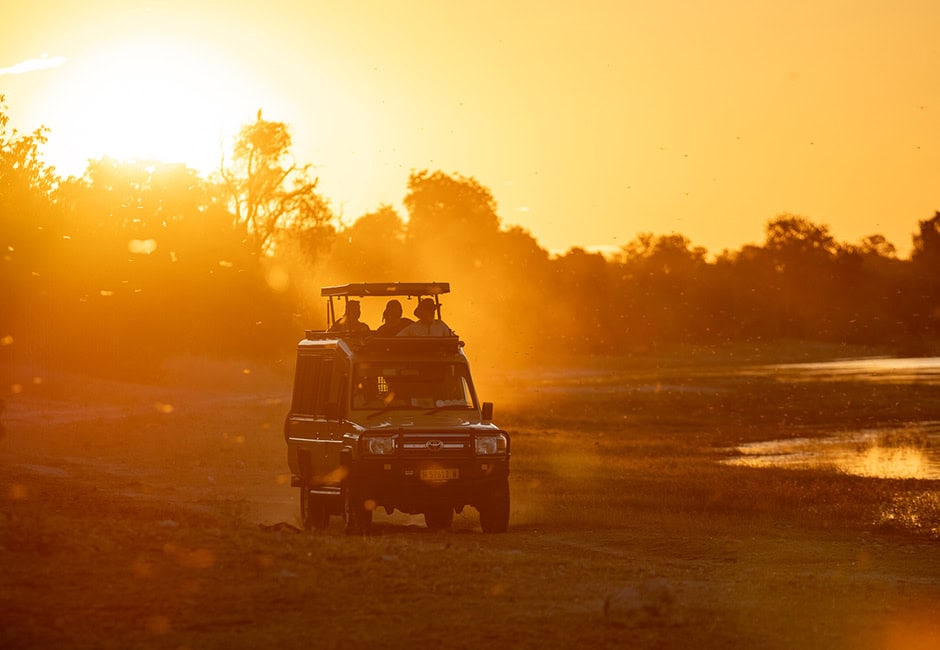
Their route leads them towards the Chobe River. Water levels here are usually still good, but become much better once the rainwater from the Angolan highlands arrives here from around May. Safaris on land in a Land Cruiser or on the water on romantic boat trips fascinate more and more given the astonishingly diverse wildlife on both sides of the banks.
April and May are the best time to travel to Chobe National Park if you …
- like transitional landscapes from the rainy into the dry season.
- prefer pleasant daytime temperatures of around 25°C to 30°C with dry air at the same time.
- favour safaris outside the central European main travel season.
- plan to combine your trip with a visit to Victoria Falls.
- love boat trips surrounded by hippos, crocodiles, buffalo, elephants and countless waterbirds.
- want to capture photos of morning mist over lagoons and rivers, of sunsets and starry night skies, and of wildlife in and along rivers.

June – August: romantic moments and wildlife at the waterholes
The months June to August belong to the dry season and thus to the best time to travel to Chobe National Park.
The air becomes increasingly dry and dusty. The dryness can no longer be overlooked at this time of year. Lush green has turned yellow-brown in many places. Of once-abundant vegetation, often only skeletons are left to see.
Temperatures drop further. In June they bring ever cooler nights and eventually even fall below 10°C. During the day they still reach over 25°C. But for evenings and mornings you should have a jacket or a warm jumper with you. You are right in the middle of the coldest months of the year.
In the mornings, the cooler conditions of the night more often produce gentle veils of mist over lagoons and rivers. They disappear over the course of the day, and so at night the window to the universe opens. The civilisation-free light conditions in the wilderness give you the best views of the breathtaking starry sky.
Snakes, scorpions and spiders have long since burrowed in or retreated to warm hiding places elsewhere. Mosquitoes become fewer too. But the big game shows itself in ever greater numbers at the Chobe River. Here you now find the highest concentration of elephants in the country, if not in Africa.
Safari heart, what more do you want?
June to August are the best time to travel to Chobe National Park if you …
- want to travel rain-free, dry, with plenty of sunshine and under starry skies.
- dream of romantic boat trips into the sunset and African animal silhouettes in the evening glow.
- want to experience wildlife at the waterholes.

September and October: hot, but the best time to travel for wildlife sightings
In September you have got through the cold in Chobe National Park. Temperatures rise, both by day and by night. October is the hottest month of the year. Together with the relentless dryness, they strain nature to the point of being unbearable.
At the waterholes beyond the Chobe River, tensions rise among the animals, as does competition for ever scarcer food resources.
All the more surprising is September with its spring-like impressions. The moisture reserves gained from mist or morning dew now help nature to form fruit clusters and fragrant blossoms. But it will still be a while until the next rain.
September and October are the best time to travel to Chobe National Park if you …
- want to feel the drama after long months of drought.
- can't get enough of wildlife sightings in large numbers.
- like photographing animals and waterholes in barren landscapes.
Conclusion & personal recommendation
A visit to Chobe National Park is worthwhile all year round, as the wildlife wanders through the park with the changing seasons. This applies in particular to the Savuti area, where in the rainy months many animals, especially zebras, move into the Savuti marsh.
The region around the Chobe River is best visited in the dry season (April to October), especially from July/August.
Although it can get very hot from September already, the animals are drawn ever more strongly to the riverbank until the end of the dry season, as the other waterholes throughout the park dry up.
Unfortunately it also means a much greater volume of travellers, who in the high season show up, especially in the mornings, in longer Land Cruiser queues at the Sedudu Gate near the gateway town of Kasane.
My personal recommendation: May and June offer a good alternative: as transitional months, safari conditions are already good, but fewer people are around.
In the rainy season between November and March you see fewer animals on the riverbank. In return, many young animals are on the move in the now bushier savannahs and woodlands of the surrounding area. Bird lovers also get their money's worth at this time thanks to the migrants flying in.

I hope my remarks above – although by no means exhaustive – have given you a few ideas and some orientation as to when the best time to travel to Chobe National Park is.
We are happy to answer questions and support you with planning your Botswana trip, whether on a guided group tour, a guided private tour or a self-drive tour.
Thanks to our close contact with our subsidiary in Botswana, we are always well informed about the current situation.
So get in touch! Your dream, our expertise – your very own individual Botswana experience.
Juan Proll has lived in southern Africa since 2011 and works as a certified Nature and Cultural Guide in South Africa, Botswana and Namibia for Elefant-Tours and its subsidiaries. After an earlier career as an adult-education teacher in Germany, he swapped the classroom for the wilderness. Alongside his work as a guide, he writes for the Elefant-Tours blogs about nature, culture and sustainable travel. Juan is a member of the Field Guides Association of Southern Africa (FGASA) and the author of the books “Ich werd’ dann mal Ranger” and “Das Safari-Lesebuch”. The magazine DER SPIEGEL reported on his training.