Safari clothing: How to pack properly – general & local tips
 by Juan Proll· June 9, 2025· 9 min read· Updated June 26, 2025
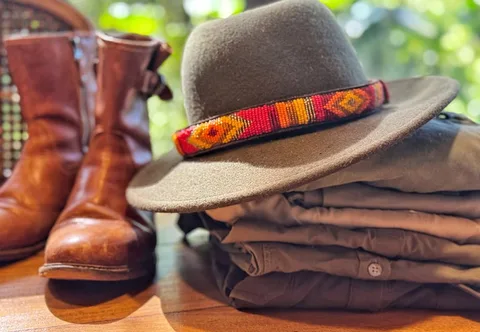
On safari, the right clothing makes all the difference. It should protect you from the sun and insects, withstand hot and cold temperatures, blend in colour-wise with the surroundings and still be comfortable and safari-chic. Here are our safari clothing tips.
General tips on safari clothing
What to wear on safari and what to watch out for are important questions, especially for safari first-timers. Here you will find helpful advice and guidance.
Choosing the right colours
If you want to see as much wildlife as possible, you should try not to stand out. So neutral clothing colours such as khaki, olive, brown, grey or blue-grey are the right choice. Lighter and darker is fine too, but please wear bright colours such as orange or neon green at most as underwear.
It is true that no wildebeest or buffalo will attack you just because you are wearing red, as most big game animals do not have anything like our colour-detection spectrum. But a few species of monkey, birds, reptiles and insects see colours very well.
If you are too colourfully dressed in an open 4x4, and especially on a bush walk , you can be spotted faster and seen as a threat. If the birds take flight because of it, big game animals also like to take that as a warning signal and make themselves scarce.
In countries such as Tanzania and Kenya you should also avoid safari clothing in black-blue. This colour combination attracts the day-active tsetse flies. Their trademark: a painful sting, a hearty gulp of blood and, as a thank-you, a nasty pathogen that can cause sleeping sickness.

Clothing for women and men
In principle, the criteria for the right safari clothing do not differ between men and women. It is about functionality, comfort and protection from sun and insects.
A classic dress code such as “men wear trousers, women wear skirts” belongs in the archives of film history. Today's recommendations for safari outfits apply to all genders: shirts, long trousers, zip-offs, safari hats.
If you would still rather wear a dress , you should, as with wearing shorts, make sure that all exposed skin is protected from the sun by day and mosquito-resistant in the evening.
On bush walks trousers should be the first choice, as fluttering dresses catch more easily on bushes and thorny branches.
You can choose your evening clothes in the hotel or restaurant more flexibly. But bear in mind that even in the more luxurious accommodation during a safari, you can quickly look overdressed in stilettos and an evening gown or black patent shoes and a tuxedo.
But if you are planning a beach holiday after the safari and want to wear formal dress in a fine restaurant in the evening, go ahead.
With a view to religion and culture, or hot spells, we recommend that women also pack airy but covering clothing. For example a large scarf that you can quickly drape over a bare shoulder when entering a mosque, or tie around your hips to cover your legs.
Men too should not walk around too revealingly in the villages of the Kenyan coast or Zanzibar. Modesty is the motto.
Authentic safaris where you can test your safari outfits:
Shoes and accessories
It is easy to understand that high heels are not suitable for a bush walk. At dinner in the lodges too, you quickly end up “overdressed” in them.
For game drives and bush walks, sturdy, closed shoes are generally suitable. Ankle-high ones are welcome, to better protect against extremely rare but possible snake bites or scorpion stings.
Flip-flops and light shoes are in turn suitable for camp. Flip-flops are nice for the room and for showering at campsites, but give mosquitoes more to attack. Light shoes are good for walking around camp, provided the paths there are gravelled.
Accessories such as sunglasses, a sun hat, and a light jacket or scarf protect against sun, wind and the freshness of the evening.

Mosquito protection & health
When it comes to safari clothing and health, you pack right with trousers, shirts, T-shirts and hats that repel UV radiation. Sunscreen is then only needed for the exposed skin on your face and hands.
Mosquito-protective clothing helps too, especially in the evening. It is either impregnated with repellent or made to be sting-proof. That spares you aggressive anti-mosquito sprays over large areas of skin, though not on the skin that stays uncovered.
In tsetse fly areas you should avoid clothing in the colour combination of black and blue altogether. For these horsefly-like flying missiles, it is like sweet honey to bees.
In the evening, protection against malaria mosquitoes in particular becomes more important. Long-sleeved, mosquito-resistant clothing is a sensible addition to other protective measures such as anti-mosquito sprays and, where appropriate, anti-malarial medication (please contact a tropical medicine institute about this!).
Safari clothing in the dry season – the African winter
In the main safari destinations, the dry season means a minimum of rain and a maximum of cold, especially at night. By day, however, it can still get very hot.
Safari clothing using the layering principle is the best option here. Wear a series of not-too-thick layers that you can take off or put back on as needed. That way you protect yourself well against cold early mornings and sweaty midday heat.
A quick-drying T-shirt could serve as the bottom layer, followed by a layer of trousers and a long-sleeved shirt. Over the shirt you can wear a fleece jacket and finally one more layer consisting of a thinner jacket that protects against wind, dust and cold.

Safari clothing in the rainy season – the African summer
In the rainy season it does not have to rain constantly, but it is definitely hot and more humid. It is also the time with the highest number of mosquitoes. So here is how to pack right for the wet, hot months:
Light, quick-drying safari clothing that offers protection from rain and wet and is breathable. At the same time it should be long-sleeved and have long trouser legs, so that you can protect yourself better against mosquitoes.
Discover Africa and the wilderness with us.
Get in touch with us!
Safari clothing by country – what to bear in mind
Tell me which country you are travelling to and I will tell you which safari clothing you need. In fact, there are small but subtle differences in top safari destinations such as Tanzania, Kenya, Namibia, South Africa and Botswana.
Tanzania – safari clothing
On the Northern Safari Circuit you move at altitudes from 1,400 m (Arusha) through 2,400 m (Ngorongoro Crater) down to 920 m (parts of the Serengeti). That means large temperature differences between day and night, so several layers of clothing make sense.
Tanzania, and on the Northern Safari Circuit especially Tarangire National Park, is also tsetse fly territory. Definitely avoid black-blue clothing here.
In the country's more conservative regions, such as Zanzibar with its strongly Muslim population, you should show respect with modest clothing that covers shoulders and legs.
Kenya
Altitudes starting at 1,900 m (Masai Mara National Reserve and Lake Naivasha), going through 1,200 m (Amboseli National Park) down to 970 m (Tsavo West National Park), mean cool conditions in the morning and evening. So wear layered clothing for game drives.
Tsetse flies are mainly a problem in Tsavo East National Park, where you should avoid black and blue.
Otherwise there are also regions here with a very conservative dress code, where you should cover shoulders and legs.
Combinations of safari and beach holiday in both Tanzania and Kenya allow you to bring a versatile wardrobe. Earth tones and bright colours, full cover and bikini.

Namibia – safari clothing
In Namibia, the desert-like conditions of the Namib and Kalahari determine the dress code: desert-typical temperature swings between day and night, extreme dryness and sandy air, but above all the most intense solar radiation.
You are well advised to wear robust clothing in general and, in particular, UV-protective clothes, wide-brimmed hats and sunglasses.
From soap to body lotion to sunscreen, you should use only moisturising products to “prime” your skin.
Otherwise you can get by with less safari clothing here if you are prepared to do small washes in between. Everything dries extremely quickly.
South Africa
When it rains in Cape Town, it is dry in Kruger National Park, and vice versa. The different climate zones call for a carefully balanced choice of clothing for all eventualities when visiting different parts of the country.
South Africa also has, in Cape Town and the wine region, a great deal of European lifestyle and Mediterranean flair. To match, you can show off your latest fashion acquisitions here, whether swimming trunks or blazer, tankini or summer dress.

Botswana
River courses and water channels shape Botswana's most famous safari destinations, the Okavango Delta and Chobe National Park. Boat and dugout-canoe safaris are a hallmark of the country. Getting wet is part of the fun. Quick-drying safari clothing is advisable.
Where there is a lot of water, there are often many insects too, which you can ward off with mosquito-protective clothing . The tsetse fly is now considered largely (!) eradicated.
The country is, by the way, not suitable for a beach holiday. For one thing, most waters are infested with hippos or crocodiles. For another, there are no coasts. That does not spare you from packing swimming trunks or a bikini – after all, some accommodations have a swimming pool. But the rest of the beach outfit can stay at home.
In the dry Kalahari regions around Makgadikgadi Pans National Park, Central Kalahari Game Reserve or Kgalagadi Transfrontier Park, durable, UV-protective clothes are needed again.
Practical packing tips for your safari
In our blog “Safari packing list” you will find our checklist for your safari clothing when heading to Africa. Space-saving tips are plentiful on the internet. For example:
Rolling clothes instead of folding them helps save space. You can leave towels at home, because they are part of the standard in safari accommodation. You should decant all lotions, shampoos and soaps into smaller sample bottles instead of taking the large packs.
In large lodges, a hairdryer is either part of the basic room equipment or you can use your travel hairdryer via a socket. In smaller, more nature-oriented tented camps this is not always the case. On a proper adventure camping safari, the options for blow-drying hair are minimal. Air-drying is the motto. If you only feel truly comfortable with a blow-dried hairstyle, it is best to mention this when planning your trip.
If you are going on a day trip or a game drive, pack a daypack with enough water, possibly snacks, sunscreen, mosquito spray as a precaution, binoculars, camera and spare batteries. A fleece and a light rain jacket are also welcome.
If you are travelling as a self-driver, please also make sure you have a fully charged phone ready for calls and a charging cable.

What is the best suitcase for a safari?
The best suitcase for a safari is in fact not a suitcase but a soft travel bag, sometimes also called a duffle bag.
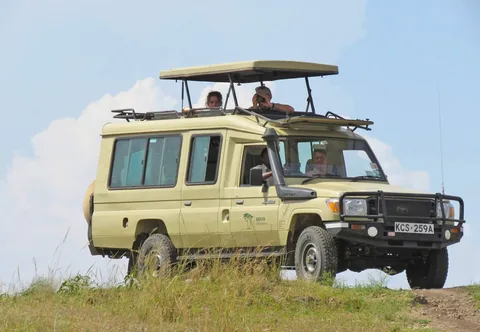
The 4×4 Toyota Land Cruisers frequently used on safaris are spacious inside, but have a comparatively really tiny boot. Especially on group tours or private trips with six or seven guests, the boot is packed to the brim. Large hard-shell suitcases take up the most space and do not give an inch.
If necessary, a suitcase then has to be placed in the interior of the safari vehicle or on the roof. And crashing over suitcases during a leopard sighting is not exactly ideal.
That is why one of the most important packing tips for a safari is probably this: do not take too much!
Conclusion – well dressed for a safari adventure
The right safari clothing is crucial for an unforgettable Africa experience. Light, breathable and robust clothing protects against scrapes, snake bites, sun, sand and insects. Neutral colours are good for undisturbed wildlife viewing.
Remember to also bring headgear, sunglasses and sunscreen. Take note of the special requirements of your destination country so that you are well prepared with the suitable clothes in your luggage.
With the right equipment, you can make the most of the beauty of the African wilderness while feeling comfortable and protected. With that in mind, enjoy your safari adventure!
We are happy to answer questions, support you in planning and accompany you throughout the tour. Whether you are travelling on a privately guided round trip, a group tour or a self-drive tour.
Thanks to our close contact with our subsidiaries in five popular travel countries in Africa, we are always well informed about the current situation.
So get in touch with us! Your dream, our expertise – your very own Africa experience.
Juan Proll has lived in southern Africa since 2011 and works as a certified nature and cultural guide in South Africa, Botswana and Namibia for Elefant-Tours and its subsidiaries. After an earlier career as an adult education teacher in Germany, he swapped the classroom for the wilderness. Alongside his work as a guide, he writes for the Elefant-Tours blogs about nature, culture and sustainable travel. Juan is a member of the Field Guides Association of Southern Africa (FGASA) and author of the books „Ich werd’ dann mal Ranger“ and „Das Safari-Lesebuch“. The magazine DER SPIEGEL reported on his training.