Namibia packing list: What you need for your trip
 by Juan Proll· July 14, 2025· 10 min read· Updated August 8, 2025
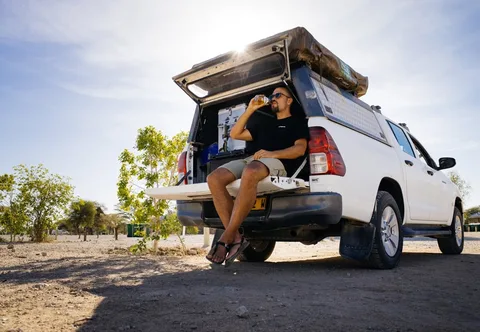
Namibia – land of the Kalahari and the Namib Desert. A place full of natural beauty and extreme conditions that are part of the adventure and call for well-chosen luggage. Here you will find tips for a Namibia packing list and what you need for your trip.

The basics – what no Namibia packing list should be without
Namibia lies in the far southwest of Africa. It is too far away to just drive back home because you forgot something. This Namibia packing list aims to make sure that never happens. I have linked a separate checklist here.
Important travel documents & papers
- For Namibia you need a passport. Make sure it is still valid for at least 6 months and has at least three free pages for stamps. Check in good time so that, if in doubt, you can still apply for a new passport.
- If you are planning a self-drive trip to Namibia, you need your national driving licence plus an international driving permit. The latter also takes time to apply for. If you already have one, make sure it is still within its 3-year validity.
- Proof of valid travel health insurance may also be requested on entry. When taking out a policy, make sure it includes medical repatriation, to cover the costs of transfer home for further treatment.
- Since April 2025, a tourist visa has been mandatory for travellers from Germany, Austria and Switzerland. It can be applied for on arrival or in advance online from home. If you do it online at https://eservices.mhaiss.gov.na/visaonarrival, do it a few days before entry. Carry the approval with you as proof.
- Copies & digital backups of all your documents, which you can access while travelling and which your authorised contacts can access from home, are always recommended. Keep the copies separate from the originals. And make sure that password-protected digital backups can also be opened by your trusted contacts during this time.
Cash & means of payment
- Credit cards are widely accepted in Namibia. Even so, you should be prepared for the fact that smaller shops in particular – especially in rural regions – often accept only cash. Card payments also fail from time to time because of technical faults.
- Having cash with you is therefore generally a good idea. That way you are less dependent on your credit card and also have the small change you need for tips. As a self-driver, I make sure you have enough to buy a tank of petrol.
- Petrol stations are not to be taken for granted everywhere in Namibia. In many remote areas it can quickly become critical if you are running on reserve. If you then come across a station where card payment does not work, you may not make it to the next one without cash. Planning your refuelling ahead is therefore strongly recommended.

Travel first-aid kit
In a vast travel country like Namibia, with few inhabitants and modest healthcare infrastructure, organising your travel first-aid kit is important.
- Bring your own necessary medication in a quantity suited to the trip (for heart, thyroid, breathing, etc.). Some preventive medication should also not be missing (diarrhoea, allergies, malaria, insects, painkillers, etc.)
- A small supply of dressing materials, plasters, sterile swabs, if applicable sterile-packed disposable syringes, and wound and healing ointment should also not be missing.
- Sun protection with sunscreen, sunglasses and a sun hat is very important.
Technology & accessories
In technology and accessories too, planning ahead helps. If something is missing or breaks, getting a replacement is limited to a few towns. And who wants to spend their holiday on “shopping errands”?
- A camera with a zoom lens is recommended. Phones can do a lot these days, even in the zoom range. If you have a traditional camera, the zoom should have a focal length of at least 400 mm for animals and birds further away.
- The chargers for your camera and phone also belong in your luggage. Add the necessary country-specific adapter (type D/M) and, as a precaution, a power bank.
- Anyone with a powerful zoom camera in their luggage is happy to do without binoculars for wildlife viewing. Everyone else I warmly recommend taking binoculars. They simply make the wildlife even more beautiful.
- You should also definitely have a torch, whether built into your phone or separate. Not all paths are lit in the dark, and a power cut is possible from time to time (even if rare).

Clothing for Namibia – functional & versatile
Namibia and its deserts are a land where it can be very hot by day but very cold at night and where the air is very sandy and dry. So here are a few clothing tips for your Namibia packing list and what you need for your trip.
Clothing for warm days & cool nights
- By day the sun burns almost without pause. There is hardly any shade. Light, breathable clothing (shirts, T-shirts, trousers, etc.), ideally with built-in sun protection, is recommended.
- Depending on the region, such as in the Kalahari, it can cool down extremely at night. And in the months of June to August, mornings, evenings and nights are cold anyway. Warm clothing (fleece jacket, hat, long trousers, etc.) must therefore not be missing from your suitcase.
- If you are out on game drives in an open 4x4, wrap up warm in the morning and in the afternoon as the sun goes down. Layers of clothing that can be taken off and put back on more flexibly are recommended.

Clothing for safari & camping
On safari, the right clothing should protect you from the sun, insects and thorny bush, withstand hot and cold temperatures, blend in colour-wise with the surroundings and still be comfortable and safari-chic.
- If you want to see as much wildlife as possible, you should generally try not to stand out. So choose neutral clothing colours such as khaki, olive, brown, grey or blue-grey. Lighter and darker is fine too, as long as you wear bright colours such as orange or neon green at most as underwear.
- High heels are not suitable for a safari, and certainly not for a bush walk. Instead, sturdy, closed shoes are generally suitable. Ankle-high ones are welcome, to better protect you against rare but possible snake bites or scorpion stings.
- Sunglasses, a sun hat, and a light jacket or scarf that protect against sun, wind and the freshness of the evening are also important.
Packing list by season – summer vs. winter
A “summer” or “winter” in the southern hemisphere cannot be compared with central European standards. In Namibia, summer is the hot rainy season and winter is the colder dry season. Both have consequences for your Namibia packing list and what you need for your trip.
Travelling in the Namibian summer (November–April)
- Despite the official rainy season between November and April, many regions of the country stay dry, especially the more southern areas. The rather short showers are concentrated on the towns in the highlands and the far northeastern areas.
During this time the temperature barometer happily climbs, depending on the region, to well over 30°C and between January and March even above 40°C. Light, airy clothing is called for, and rain protection for short showers is advisable.
Since it is also the most mosquito-rich time , I recommend either mosquito-proof clothing or protecting exposed areas of skin with insect repellent, especially in the evening.
Travelling in the Namibian winter (May–October)
- More reliable than the rainy season is the dry season between May and October. It is dry and often dusty. Between June and August it is also cold in the evening and morning, and colder still at night. During the day it is sunny and pleasantly warm.
Clothing-wise, you should be able to put things on and take them off flexibly on these days. So wear several layers on the onion principle, for example a functional vest + T-shirt + jumper + jacket. Your head will even be glad of a hat.
Anyone who is particularly sensitive to cold in the hands should also pack gloves .
Want to find out more about Namibia trips?
We are happy to advise you. Get in touch with us!
Equipment for self-drivers & camping fans
For most of the year, Namibia is ideal for self-drivers and camping fans. Depending on the region, it can occasionally become unpleasant in high-rainfall areas, despite showers tending to be short.

What you need for camping
- Rental cars with rooftop tents are increasingly popular. As a rule this not only gives more security but also makes setting up, taking down and stowing the camping equipment easier.
- For camping in particular, besides a tent of some kind you also need other things. These include a foam or air mattress, a sleeping bag (plus liner), and possibly an inflatable pillow.
- Some technical aids should not be missing. These include a head torch so that you have both hands free in the dark; an outdoor multi-tool pocket knife for cutting, opening, screwing and sawing; a lighter or weatherproof matches (“cowboy matches”).
- And of course you need pots, a stove, gas cartridges, crockery, etc., which you do not necessarily need on your Namibia packing list, but can hire locally. The same applies to washing-up and cleaning products or a hand brush to sweep out the tent.
For the round trip in a rental car
- If you are travelling in your own rental car on a camping tour , the vehicle's equipment takes on greater importance than on a lodge tour. A second spare tyre, an electric cool box, spare petrol cans, drinking water containers and offline maps should be considered.
- A second phone with a different provider for wider network coverage, as well as cash for at least one tank of fuel and rubbish bags, are also important to pack.
Top Namibia tours:
Common packing mistakes – and how to avoid them
Forgetting something can sometimes be tragic. Especially when you urgently need it but do not have it. Or you have too much with you and ask yourself in the end: “Why did I bring so much? And what do I need this or that for?” Here are some typical packing mistakes:
- The wrong suitcase: On safari, whether as a self-driver or on a guided tour, you should choose a soft travel bag instead of a suitcase for more stowing flexibility. Also pay attention to the weight limits of the airline (including on domestic flights) and of the guided-tour provider.
- Too much clothing: On a Namibia trip, clothing is about functionality, comfort and protection from sun and insects, so: shirts, long trousers, zip-offs, safari hats for all genders. Go for versatile basics instead of fashionable individual pieces.
- Wrong footwear: In glorious weather, light shoes such as sandals are a real liberation. Nothing wrong with that. But please do not forget sturdy footwear such as outdoor or hiking shoes. If you get out and walk around, you can change into them quickly.
- No offline navigation: Navigation that relies on the mobile network is not a good idea in Namibia, because in some regions it is too weak or non-existent. Download offline maps beforehand and also use the satellite-based Google Maps app on the road.
- Forgetting important things: Adapters, batteries or sun protection can, if absolutely necessary, still be bought in the destination country. But other things such as certain medication, a spare pair of glasses or spare lenses are probably not available – and suddenly small things have a big effect.

Personal tips from the guide
When it comes to packing, I try to be very focused. That does not necessarily protect me from mistakes, but hopefully from major blunders:
- You should take important things in your hand luggage. These include travel and ID documents, money and bank cards if they do not fit on your body. Phone, camera and laptop go without saying.
Otherwise definitely also take medication, toothbrush, contact lens case and cleaning solution, spare glasses, travel guide, chargers, a few socks, a set of underwear, a T-shirt and something to cover your head. For a beach holiday, swimming trunks or a swimsuit and flip-flops should also go in.
I usually carry items such as toothpaste, sunscreen and hand cream in hand-luggage-friendly sizes. What exactly is important will certainly vary individually, though.
The decisive question when thinking it through is therefore: “What if my checked suitcase is not on the baggage belt at my holiday destination and I have to manage without it for three or four days? What should I then have in my hand luggage?” - Please also think of protective covers for camera and phone to shield them against fine sand when winds pick up and you are out on foot.
- And if you are used to packing your belongings in plastic bags, you should rethink quickly. In Namibia too, a ban on single-use plastic is increasingly taking hold. So please use packaging free of single-use plastic.
- Otherwise, for luggage, less can be more and versatility is key. So if you have a pair of pants that you can also wear as a hat or put in your shoe as an insole, it belongs in the suitcase. Good organisation of your luggage saves time and space.
- If you have questions, our travel experts will gladly advise you in advance on ideal preparation.

Conclusion: well packed is half the journey
The right luggage is crucial for an unforgettable Namibia experience. Light, robust and breathable clothing protects you from scrapes, sun, sand and insects. Sweaters, jumpers, fleeces and wind and rain jackets protect you from cold and rain.
Neutral colours are good for undisturbed wildlife viewing.
For Namibia's intense sun, headgear, sunglasses and sunscreen are also important.
Our detailed checklist gives you a few more pointers right away, so that with the right equipment you can make the most of the beauty of Namibia while feeling comfortable and protected.
So off you go into the Namibian adventure, where we will gladly welcome you warmly. For further questions and support in planning your Namibia trip, we are happy to help.
Thanks to our close contact with our subsidiary in Namibia we are always well informed about the current situation. So get in touch with us! Your dream, our expertise – your very own Namibia experience.
Juan Proll has lived in southern Africa since 2011 and works as a certified nature and cultural guide in South Africa, Botswana and Namibia for Elefant-Tours and its subsidiaries. After an earlier career as an adult education teacher in Germany, he swapped the classroom for the wilderness. Alongside his work as a guide, he writes for the Elefant-Tours blogs about nature, culture and sustainable travel. Juan is a member of the Field Guides Association of Southern Africa (FGASA) and author of the books „Ich werd’ dann mal Ranger“ and „Das Safari-Lesebuch“. The magazine DER SPIEGEL reported on his training.